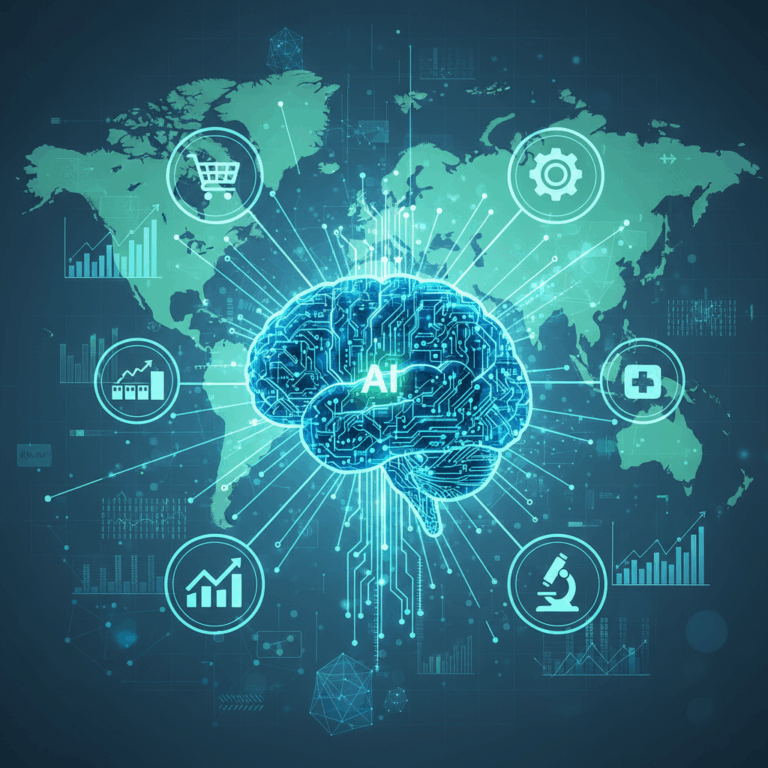
Successes of artificial intelligence in global companies
Artificial intelligence has transformed the way companies operate, generating key competitive advantages through innovation and efficiency. Large corporations have adopted AI to optimize processes and improve the customer experience.
These examples show how AI not only automates tasks, but also provides personalization, precision in analysis and strategic improvements. Thus, they position themselves as leaders in their sectors and promote new growth opportunities.
In this context, we will highlight two emblematic cases: Amazon, with its advanced logistics and customization, and Spotify, which has revolutionized the music industry with intelligent recommendations.
Customization and logistics on Amazon
Amazon uses artificial intelligence to adapt product recommendations to the specific preferences of each user. This increases sales and improves customer loyalty by providing unique and relevant experiences.
In addition, AI optimizes your logistics processes. It allows you to predict demand, plan efficient delivery routes and manage inventories with greater precision, which reduces costs and streamlines service.
The Alexa assistant is another example of an application, using natural language processing to interact intuitively, improving attendance and user relationships.
Recommendations and experiences on Spotify
Spotify has transformed the music experience through algorithms that analyze the listening habits of its users. This makes it possible to offer personalized lists and songs that increase retention and time on the platform.
The application of AI allows you to detect patterns and anticipate tastes, making it easier to discover new music adapted to individual preferences. This generates a deeper connection with the user.
Thus, Spotify not only offers content, but also unique musical experiences that build audience loyalty and enhance its leadership in the digital market.
Advanced AI applications in different industries
Tesla has revolutionized the automotive industry by integrating AI into big data to improve its autonomous driving system. This guarantees greater safety and efficiency in your vehicles.
On the other hand, Netflix applies artificial intelligence to analyze behavioral patterns and offer personalized content, increasing the satisfaction and usage time of its users.
Companies like Google and JP Morgan Chase also leverage AI to maximize results. From personalized advertising to financial analysis, they transform their sectors with decisions based on advanced data.
Autonomous driving and safety at Tesla
Tesla uses machine learning algorithms to process data in real time and optimize the autopilot of its vehicles. This reduces human errors and improves the driving experience.
AI systems make it possible to detect obstacles, anticipate risks and react quickly to complex road situations, raising safety and reliability standards.
In addition, Tesla continually updates its software to adapt to new scenarios, making its cars increasingly smarter and more autonomous.
Optimization of entertainment on Netflix
Netflix uses artificial intelligence to analyze the viewing habits and habits of each user, recommending content that fits their preferences.
Thus, the platform maximizes retention and loyalty by offering series and movies that capture attention in a personalized way, improving the experience.
This data-driven strategy also allows Netflix to anticipate trends and develop original productions with a greater probability of success.
Results and advertising on Google
Google uses AI to accurately interpret user queries, providing more relevant and useful results in its search engine.
Additionally, it optimizes online advertising, personalizing ads to maximize advertisers' return on investment through algorithms that accurately segment audiences.
These capabilities allow Google to maintain its leadership in the digital market and offer experiences adapted to both users and companies.
Financial analysis with AI at JP Morgan Chase
JP Morgan Chase uses artificial intelligence to analyze large volumes of financial data and predict market behavior more accurately.
This allows us to offer personalized recommendations and manage risks more effectively, benefiting both investors and clients.
The integration of AI into its processes optimizes decision making and improves competitiveness in a highly dynamic and demanding sector.
AI-powered trends and marketing
Artificial intelligence has revolutionized the way companies understand and anticipate consumer preferences, enabling much more effective marketing strategies.
AI tools analyze large volumes of data to identify emerging trends and adapt campaigns in real time, improving connection with the target audience.
Coca-Cola consumption prediction
Coca-Cola uses AI to analyze data from social networks and other sources, detecting consumer trends before they become widespread, allowing product innovation in a timely manner.
This artificial intelligence-based strategy adjusts the offering and adapts marketing campaigns to align new products with the changing preferences of the global market.
Additionally, AI improves resource planning and distribution, ensuring that Coca-Cola's presence is optimal at key times based on consumer behavior.
Strategic and competitive impacts of AI
Artificial intelligence drives one strategic revolution in companies, optimizing processes and improving the ability to constantly innovate. This translates into clear competitive advantages.
Companies that integrate AI not only increase efficiency, but also foster a culture of innovation that allows them to quickly adapt to market changes and develop new products.
Thus, AI becomes a key factor in maintaining and expanding the position in the industry, enabling continuous improvements in its operations and customer experience.
Innovation and operational efficiency
AI automates repetitive tasks, freeing up human resources for higher value activities. This increases operational efficiency and reduces errors in critical processes.
In addition, it provides predictive analysis that anticipates demands and allows better strategic planning, facilitating agile responses to challenges and opportunities in real time.
Innovation is enhanced through AI, which generates creative solutions based on the analysis of large volumes of data, transforming the way products and services are designed.
New business opportunities
The adoption of AI opens the door to disruptive business models, such as personalized services and intelligent platforms that were not possible before.
Companies can detect emerging market niches and develop offers tailored to the specific preferences of different customer segments.
Additionally, AI facilitates collaboration and the creation of digital ecosystems, connecting actors and accelerating joint innovation to access new revenue streams.