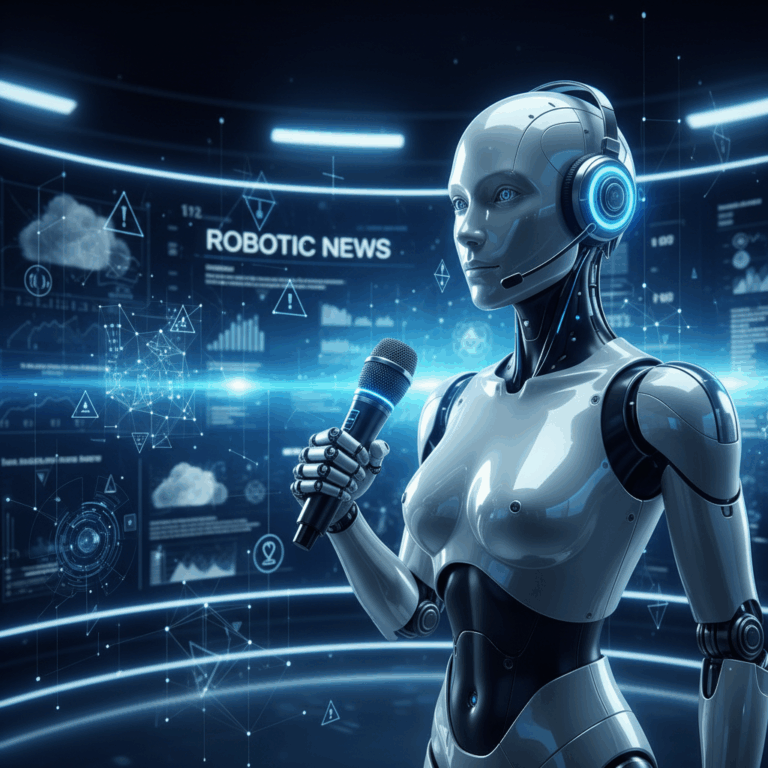
Technological advances in advanced robotics
In 2025, advanced robotics is experiencing a time of transformations thanks to advances in artificial intelligence and sensory technologies. Humanoid robots achieve new cognitive abilities.
These advances allow robots to interact more naturally with humans and execute complex tasks. This opens up a range of possibilities in varied sectors and improves the autonomy of the machines.
Experts estimate that up to 300 million humanoids will be in use, reflecting rapid evolution and its growing impact on global society and economy.
Artificial intelligence applied to humanoids
Artificial intelligence applied to humanoids has reached a sophisticated level, allowing them to process natural language and adapt creatively to different environments. This facilitates more human interactions.
Robots like Figure 01 and Ameca are examples of this revolution, having fluid conversations and learning by observing, thanks to advanced neural networks integrated into their systems.
This evolution drives its use in varied areas, from logistics to customer service and support for older people, making humanoids efficient and versatile allies.
Improvements in sensors and autonomous capabilities
Improvements in sensors allow robots to have advanced visual and auditory perception, essential for recognizing objects and responding appropriately to various commands.
The autonomy of robots has also improved with systems capable of interpreting data in real time and making intelligent decisions that optimize industrial and social processes.
Additionally, the integration of exoskeletons and soft robotics expands manipulation capabilities, enabling robots to handle delicate objects and assist with complex physical tasks.
Applications of humanoid robots in different sectors
Humanoid robots are transforming multiple sectors in 2025, applying their advanced intelligence and autonomy to optimize processes and improve quality of life.
Thanks to their capabilities, these robots not only perform physical tasks, but also interact socially, developing essential roles in industries and personal services.
This diversity in applications drives a deep integration of robotics into modern society, expanding its impact beyond traditional automation.
Impact on industry and logistics
Humanoid robots improve efficiency in industry and logistics by interpreting data and making decisions in real time, reducing costs and errors.
Their ability to collaborate with humans and adapt to dynamic environments facilitates complex processes, from materials handling to quality control.
Innovations such as soft robotics allow fragile objects to be manipulated, and exoskeletons amplify human strength, revolutionizing physical work in factories and warehouses.
Use in health and personal care
In the health sector, humanoids assist in the monitoring, rehabilitation and support of patients, improving personalized and continuous care.
Their ability to recognize and respond to human needs makes them valuable allies in the care of the elderly and people with reduced mobility.
In addition, these robots facilitate delicate healthcare tasks, integrating advanced sensors to ensure precision and safety in clinical procedures.
Assistance and social robotics
Humanoid robots play a growing role in social robotics, providing companionship, assistance and emotional support to different population groups.
Equipped with sensors and adaptive AI, they can interact naturally, fostering inclusion and improving quality of life in home and community environments.
This healthcare robotics opens new avenues for technological integration in daily activities, facilitating the autonomy and well-being of many people.
Global leadership in robotic development
Leadership in advanced robotics is primarily dominated by China and the United States, which drive crucial innovations to transform multiple sectors. These powers invest heavily in disruptive technologies.
Both countries develop humanoid robots with surprising capabilities, competing for technological supremacy and setting trends in mobility, interaction and autonomy.
Their constant progress reflects the level of commitment to integrate robotics into the global economy and daily life, positioning them as global leaders in this field.
Roles of China and the United States
China stands out for implementing robots in industries, logistics and sporting events, promoting humanoids that demonstrate exceptional strength and speed, even in marathons and competitions.
The United States, for its part, promotes technologies linked to advanced artificial intelligence, machine learning and collaborative robotics, thus achieving enormous advances in autonomy.
Technological rivalry fosters an accelerated pace of development, where each country enhances the use of sensors, neural networks and synthetic skin to improve human-robot interaction.
Innovations of key companies
Companies like PAL Robotics and EngineAI lead innovation by creating humanoids with touch-sensitive synthetic leather, increasing naturalness and effectiveness in communicating with humans.
These companies develop robots capable of learning and improvising, integrating technologies that allow emotional and adaptive responses in complex environments.
High investment in research and development has resulted in robots that not only perform tasks, but also collaborate in social and work environments, proposing new forms of interaction.
Challenges and future perspectives
The accelerated advance of robotics raises various questions ethical and social challenges related to the integration of intelligent robots in our daily lives.
Living with autonomous humanoids requires a deep debate about responsibilities, privacy, and limits on human-machine interaction.
In addition, future prospects include transformations in the workplace and social spheres, due to automation and increasing collaboration with robots.
Ethical and social implications
Robots with advanced intelligence generate dilemmas such as the protection of personal data and the definition of limits in autonomous decision-making.
It is essential to establish regulations that regulate its use, guaranteeing that they respect human rights and do not perpetuate bias or discrimination.
Likewise, social acceptance depends on transparency and trust in technology, promoting a balance between innovation and ethical values.
Labor integration and evolution of coexistence
The incorporation of robots into work modifies traditional roles and creates new opportunities for human-machine cooperation in complex tasks.
It is necessary to adapt job training and policies to facilitate this integration, avoiding exclusion and promoting equitable development.
In daily coexistence, advanced humanoids must achieve natural and safe interactions, contributing to well-being without replacing fundamental human relationships.