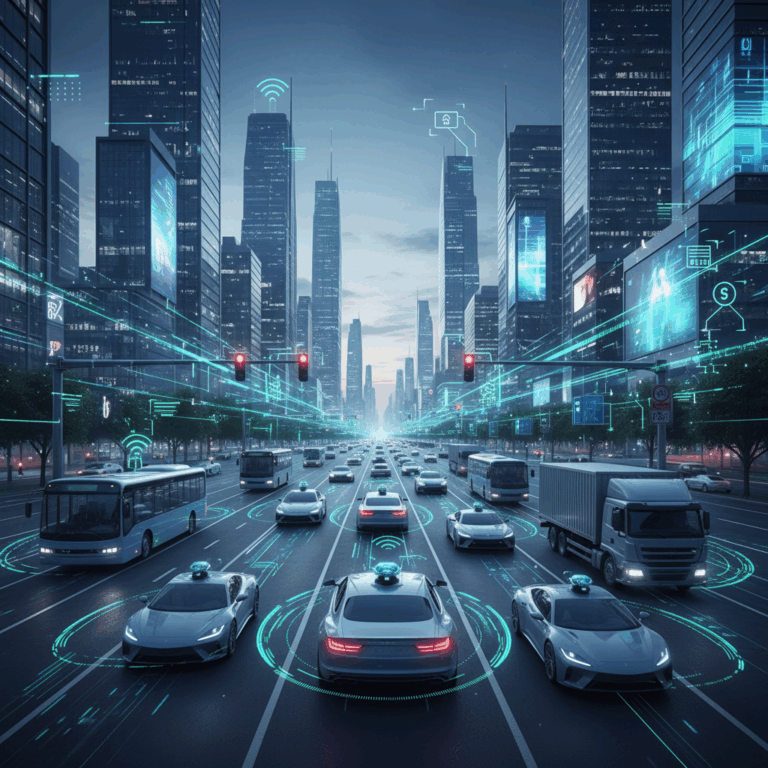
Fundamentals of autonomous vehicles
The autonomous vehicles they represent a crucial innovation in mobility, combining advanced technology and artificial intelligence to operate without human intervention. These cars are designed to understand and react to their environment accurately and quickly.
Its operation is based on a complex network of sensors and systems that constantly collect data from the environment, processed in real time to make safe decisions. Thus, they transform traditional driving into an automated and optimized process.
This change promises not only a new era in transportation, but also significant improvements in safety, efficiency and sustainability, key aspects for the future of urban mobility.
Technologies and sensors used
Autonomous vehicles use a combination of sensors such as radars, LIDAR and cameras that capture detailed information about the environment. These devices allow you to detect objects, pedestrians and traffic conditions in real time.
In addition, they incorporate systems computer vision and GPS to generate accurate maps and position yourself correctly on the road. This integration ensures that the vehicle has a complete and updated perception of the environment where it circulates.
Merging data from these sensors is crucial to eliminate errors and ensure that the vehicle correctly interprets its environment before executing any maneuver.
In the development of this technology, leading companies invest in increasing precision and reducing the number of sensors without losing functionality, betting on more powerful processors and improved algorithms.
Processing and decision making in real time
Once data is collected, intelligent systems process information instantly to interpret movements, calculate risks and anticipate dangerous situations. This allows the vehicle to decide when to brake, accelerate or turn safely.
Artificial intelligence algorithms analyze patterns and predict behaviors of other road users, increasing the ability to respond to complex and changing scenarios. Thus, the car works with adaptive and reliable autonomy.
Decisions are made in fractions of a second, requiring high computational efficiency and optimized codes that minimize errors and delays in the interpretation and execution of driving orders.
This processing also facilitates the integration of the vehicle with other elements of the infrastructure and vehicles, promoting connected and coordinated mobility, the basis for the evolution towards completely autonomous systems.
Connectivity and communication in mobility
The connectivity it is essential for the evolution of mobility, allowing vehicles and infrastructure to interact in real time. This improves safety and efficiency on urban and rural roads.
Technologies based on permanent communication between mobile and stationary elements integrate data that facilitate intelligent and early decisions, avoiding accidents and improving vehicle flow.
This interaction is the basis for the development of advanced transportation systems that respond to changing environmental conditions and the dynamic needs of users.
Internet of Things applied to transportation
The Internet of Things (IoT) connect vehicles, traffic lights, sensors and roads to share key information about traffic status and environmental conditions in real time. This enhances more efficient transportation management.
Through this communication, the systems anticipate incidents, regulate circulation and coordinate actions to avoid congestion and accidents, increasing road safety and optimizing resources.
The IoT in transportation drives an interconnected network where each element contributes to the intelligent and adapted control of vehicle flow, facilitating personalized and innovative services.
Infrastructures with smart sensors allow flow monitoring, detecting obstacles and sending alerts to drivers or directly to autonomous vehicles to act quickly.
Interaction between vehicles and road infrastructure
The communication between vehicles and infrastructure creates a connected ecosystem that facilitates coordination on the roads. This exchange improves risk detection and traffic management in real time.
Autonomous cars receive data from traffic lights, signals and cameras, allowing them to anticipate changes and adjust their driving to avoid accidents and improve traffic flow.
This integration also supports services such as dynamic speed control, adverse condition alerts and access to optimized alternative routes that reduce travel times.
Additionally, equipped road infrastructure offers crucial support for ADAS functions and automated systems, facilitating the evolution towards safer and more coordinated mobility.
Benefits in safety and efficiency
The constant connection between vehicles and infrastructure significantly reduces accidents, eliminating human errors and anticipating dangerous situations that would be difficult to detect in time.
Efficiency is improved thanks to route optimization, speed adjustments and intelligent traffic management, which reduce traffic jams and unnecessary fuel consumption.
These advances also provide environmental benefits by reducing polluting emissions and contribute to more accessible mobility for people with disabilities or who do not have a driver's license.
Together, this technological revolution promotes safer, more sustainable cities adapted to current and future demands for urban and interurban mobility.
Intelligent systems for traffic management
Intelligent systems applied to traffic management use artificial intelligence to analyze data and improve urban circulation. Its objective is to reduce congestion and increase road safety.
By collecting and processing information in real time, these systems allow vehicle flows to be dynamically adjusted, problems anticipated, and the use of existing infrastructure optimized.
The integration between vehicles, traffic lights and control centers creates a connected ecosystem that transforms mobility into more efficient and sustainable cities.
Algorithms for optimization and prediction
AI algorithms detect patterns in traffic data and predict congestion situations in advance, making it easier to make decisions to mitigate traffic jams.
These models use machine learning to adapt to changes in vehicle volume and behavior, continually improving their predictive and responsive capabilities.
By optimizing routes and traffic light times, algorithms reduce waiting times and increase fluidity, which also reduces polluting emissions associated with stopped traffic.
Likewise, this technology allows managing unforeseen events, diverting traffic and coordinating resources to maintain mobility in optimal conditions.
Integration of urban infrastructure
Technological integration between sensors, cameras and urban control systems is essential for efficient traffic management. This connection offers real-time data to improve management.
Smart cities implement communication networks that synchronize traffic lights and traffic signals, promoting coordinated circulation and avoiding unnecessary stops.
The connected urban infrastructure also enables direct interaction with autonomous vehicles and ADAS systems, facilitating safe maneuvers adapted to the environment.
Interesting fact
The implementation of smart systems in several cities has managed to reduce average travel time by up to 25%, improving quality of life and urban productivity.
These solutions range from vehicular traffic control to public transport management, providing a comprehensive approach to urban mobility.
Challenges and future of autonomous mobility
Autonomous mobility faces significant challenges that limit its full adoption, although ADAS systems are moving forward to offer partial driver support. These limitations include adaptation to unforeseen conditions and the need for human intervention.
The future of this technology depends on the continuous development of algorithms that improve the ability to learn and respond to complex situations, in addition to the improvement of hardware and connected infrastructure.
As these barriers are overcome, a profound transformation is expected in transportation, with fully autonomous vehicles and intelligent systems that optimize urban mobility and road safety.
Current limitations and ADAS systems
Currently, autonomous vehicles still do not reach full autonomy, requiring constant supervision of the driver in complex or unforeseen situations. This limitation is key to ensuring safety and control.
ADAS (Advanced Driver Assistance Systems) systems act as support, offering functions such as automatic braking, lane keeping assistance and automated parking, increasing the safety of the driver and pedestrians.
These technologies, although limited, represent an important step towards complete autonomy, providing functionalities that facilitate driving and reduce human errors, and are improved through constant updates.
Technological advances and future perspectives
Advances in artificial intelligence include the development of more sophisticated algorithms capable of learning from large amounts of data and adapting to unknown scenarios, improving vehicle decision making.
The hardware is expected to become increasingly compact and efficient, with powerful processors that reduce dependence on multiple sensors, facilitating the integration of autonomous vehicles into the mass market.
Furthermore, the improvement of connected infrastructure and the massive implementation of the Internet of Things will enhance these systems, allowing safer, more sustainable and coordinated mobility in smart cities.
Interesting fact
Leading companies are already testing fleets of autonomous vehicles in controlled urban environments, which could accelerate the popularization of this technology in the coming years, transforming the way we get around.
These pilot projects help collect real data that fuels AI learning, improving its performance and security ahead of mass, globally regulated adoption.