Economic transformations driven by AI
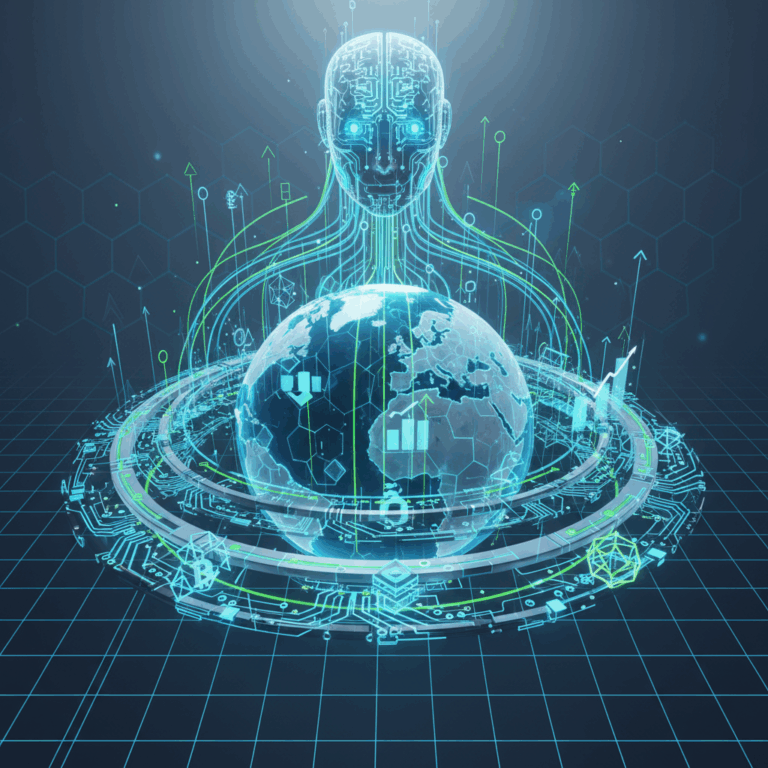
The artificial intelligence it is revolutionizing the global economy, accelerating processes and increasing efficiency in multiple sectors. This technological change is comparable to past revolutions such as the internet or the steam engine.
Its influence drives substantial growth in the World GDP by optimizing work and creating new economic opportunities. AI redefines productive bases and traditional business models.
Furthermore, the integration of AI brings with it social and economic challenges that require appropriate policies to maximize benefits and minimize negative impacts on the workforce and society.
Increased productivity and GDP growth
AI allows you to automate even the 45% of work tasks, which translates into greater productivity and reduced operating costs. These advances directly impact global GDP growth.
Projections indicate that by 2030, AI could increase global GDP by one 14%, generating trillions of additional dollars each year. This is due to increased efficiency and innovation in services and products.
The improvement in productivity is reflected in diverse sectors, where AI optimizes everything from manufacturing to healthcare, driving economic development and opening avenues for new personalized products.
New business models and benefited sectors
AI drives the creation of new business models that take advantage of data, automation and predictive analysis to generate added value. Companies adopt intelligent solutions to innovate and capture markets.
Sectors such as health, transportation, finance and education are highly benefited, with improvements in medical diagnostics, efficient logistics and personalized financial services thanks to AI.
This transformation leads to the opening of emerging niches, promoting the emergence of technological startups and the consolidation of industries focused on innovation with artificial intelligence.
Effects of AI on employment and the workforce
AI is transforming employment with both positive and challenging effects. Automating routine tasks redefines roles and competencies in the labor market.
This technological revolution drives the need for new training strategies and the development of skills that facilitate adaptation to a changing work environment.
The changes generate social tensions and cause greater polarization in the workforce, with different impacts depending on sectors and educational levels.
Automation and risks for routine jobs
AI-powered automation puts jobs that involve repetitive and mechanical tasks at risk, especially in manufacturing and basic services. This creates uncertainty for affected workers.
With up to 45% of work activities automated in advanced economies, many jobs may disappear or require less direct human intervention, mainly affecting low-skilled jobs.
However, the efficiency gained favors sectors with high demand for creative and strategic skills, while reducing costs and production times.
Training, reskilling and emergence of new professions
Given the loss of routine jobs, the demand for programs grows reskilling and continuous training that allows the workforce to adapt to new technologies and emerging roles.
Unprecedented AI-related professions are emerging, such as technology ethics experts, algorithm trainers and data specialists, requiring advanced technical and analytical skills.
This dynamic drives investment in vocational education and training, promoting a transition towards more complex jobs that are less susceptible to automation.
Social challenges and labor polarization
The advancement of AI threatens to increase the labor polarization, benefiting highly qualified workers while displacing employees with a lower educational level or in automated sectors.
This phenomenon can exacerbate economic and social inequalities, generating tensions and demanding public policies that promote inclusion and social protection.
Fair integration of AI into employment requires strategies that balance economic growth with equity and workforce well-being.
Geopolitical implications of artificial intelligence
The artificial intelligence it is reshaping the global geopolitical landscape, focusing strategic competitions between technological and economic powers. This phenomenon redefines traditional alliances and rivalries.
AI influences the global security and international trade, where the capacity for innovation and technological control becomes a key factor for influence and power in the global economy.
Furthermore, the rapid adoption of AI-based technologies by developing countries could change the economic hierarchy and open new opportunities for these emerging economies.
Competition between economic and technological powers
The United States and China lead investment in AI, competing for technological and economic supremacy. This rivalry drives great innovations but also political and economic tensions between both powers.
The competition includes the race to master generative artificial intelligence, automation technologies and advanced analytics capabilities that power industrial and military sectors.
Other actors try to position themselves, but the concentration of resources and talent in these powers implies an imbalance that can intensify the global technological gap.
Impact on global trade and global security
AI redefines supply chains and trade, optimizing processes and creating new business dynamics. However, it also generates risks due to potential conflicts over data and technology control.
In terms of security, the proliferation of AI can create new cyber threats and defense challenges, where technological control translates into strategic advantage for developed countries.
Global balance depends on international regulations and cooperation to avoid excessive or malicious use that could destabilize markets and world peace.
Macroeconomic outlook and future challenges
Artificial intelligence promises a significant growth in productivity, boosting the global economy. However, demographic factors such as population aging raise questions about its scope.
Furthermore, the expansion of the use of AI generates pressures on energy and material resources, affecting economic variables such as inflation and raising the need for sustainable management.
These challenges require integrated policies that harness the potential of AI while mitigating environmental and social risks, to ensure balanced economic development.
Productivity growth and demographic factors
AI is estimated to increase annual labor productivity by about one percentage point, accelerating economic growth over the next decade. This would boost innovation and efficiency.
However, population aging and declining workforce could limit this growth, reducing the net impact of AI on economic expansion.
Therefore, it is crucial to combine technological advances with policies that address demographic change and encourage labor participation to sustain growth.
Inflation, energy demand and pressure on resources
Mass adoption of AI will increase the energy demand, since the systems require a large amount of computing and data centers with high electricity consumption. This can put pressure on prices and generate inflation.
Furthermore, the extraction and intensive use of technical resources necessary to manufacture AI infrastructure amplifies environmental and economic pressure on scarce materials, affecting costs.
To address these challenges, investments are needed in renewable energy and efficient technologies that reduce environmental and economic impact while sustaining AI-driven growth.