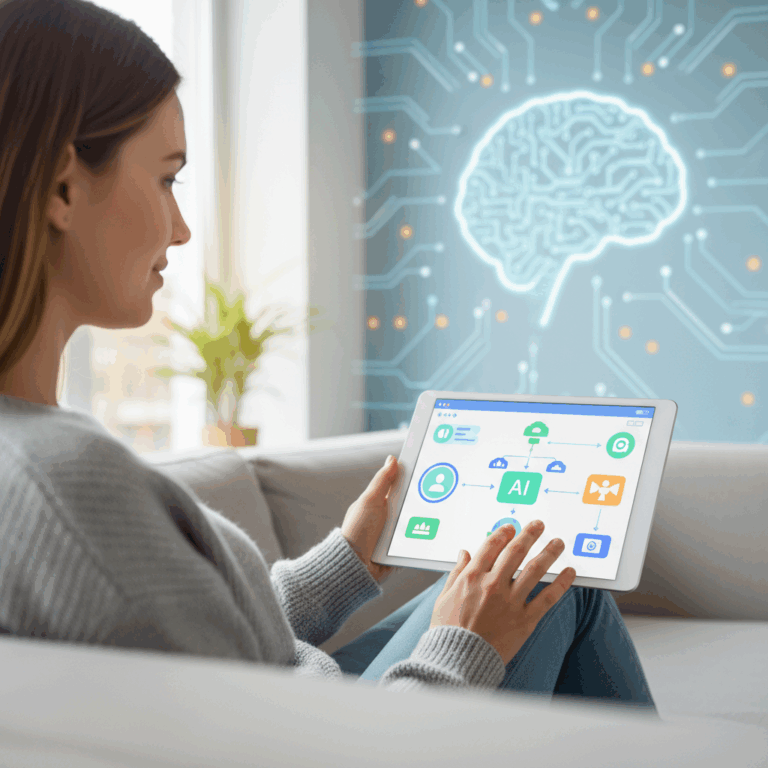
Low-code and no-code AI fundamentals
The accessible artificial intelligence it allows users without programming knowledge to explore and apply innovative solutions. Low-code and non-code platforms democratize access to AI through visual interfaces.
These tools make it easy to develop AI applications through visual editors that eliminate the need to write code. Thus, anyone can design intelligent flows and automate processes.
With a growing offering of platforms and resources, the use of AI becomes increasingly inclusive, helping both beginners and professionals without technical programming experience.
Main characteristics of low-code and no-code solutions
Low-code and no-code solutions are characterized by visual interfaces with “drag and drop” functions that simplify the creation of AI-based applications. They do not require prior programming knowledge.
They allow you to integrate machine learning, automation and data analysis components into intuitively designed workflows. Additionally, they often include pre-designed templates to accelerate development.
These platforms also offer capabilities for easily uploading data, training models, and evaluating results, encouraging rapid experimentation and prototyping of intelligent solutions.
Advantages for beginners and professionals without programming experience
For beginners, low-code and non-code platforms reduce the technical barrier, facilitating learning and creating projects with artificial intelligence without the need for programming.
Professionals without development experience can take advantage of these tools to automate tasks, improve processes and create rapid prototypes, increasing productivity and innovative capacity.
Furthermore, these solutions promote inclusive digital transformation, allowing various sectors to adopt advanced technologies without depending exclusively on machine learning experts.
Common applications and uses in accessible AI
Accessible artificial intelligence is used in various areas to simplify tasks and improve efficiency. Its applications allow inexperienced users to create valuable solutions.
From chatbots to predictive analytics, low-code and non-code tools make it easy to implement intelligent systems without programming, democratizing technological innovation.
These applications are especially useful in small businesses or departments without technical resources, accelerating processes and offering data-driven insights.
Creation of chatbots and recommendation systems
Chatbots allow you to automate customer service, offering quick and personalized responses through visual flows that are designed without code.
Recommendation systems personalize experiences, suggesting products or content based on preferences and previous data, all without the need to program.
These solutions improve interaction with users and increase operational efficiency, easily integrating into existing websites or applications.
Predictive analysis and automatic classification
Predictive analytics allows you to anticipate future trends and behaviors using historical data, facilitated by accessible, non-programmed platforms.
Automatic classification organizes documents or information intelligently, reducing errors and times in administrative or management processes.
These features support informed decision making in various sectors, from marketing to human resources, with intuitive and fast tools.
Automation of repetitive tasks
Automating repetitive tasks frees up time and resources, allowing teams to focus on strategic and creative activities without needing to program complex solutions.
Low-code/no-code platforms offer pre-designed flows for automation, facilitating their adoption and adaptation to different business processes.
This boosts productivity and improves accuracy, optimizing daily operations through accessible artificial intelligence without technical barriers.
Featured platforms for low-code/no-code AI
Low-code and no-code platforms have become key tools to democratize artificial intelligence. They allow any user to create intelligent solutions without writing code, facilitating innovation.
These platforms include intuitive visual editors and pre-built components that accelerate the development and deployment of AI-based applications, making the technology accessible at all levels.
In addition, they have advanced features that allow everything from data loading and management to model training and evaluation, simplifying complex processes.
Popular tools and their features
Among the most recognized platforms are Microsoft Power Platform, which integrates AI with business flows, Google AutoML, which facilitates the training of custom models, and IBM Watson Studio, aimed at advanced analysis.
Others like DataRobot offer full AI lifecycle automation for inexperienced users, while specialized chatbot and data analytics platforms provide simplified interfaces for specific tasks.
These tools combine functionalities such as simple integration, scalability and support for different types of data, adapting to various needs and sectors.
Using pre-designed templates and flows to make creation easier
Pre-built templates and flows are critical resources for users to launch AI projects quickly, eliminating the need to configure each step from scratch.
These templates include settings for chatbots, predictive analytics, auto sorting, and automation, which can be easily customized for each specific use case.
Using these resources allows beginners to better understand the structures of AI processes and accelerates the implementation of functional solutions without prior experience.
Training and resources to learn AI without programming
Learning artificial intelligence without programming is more accessible thanks to numerous resources focused on beginners. These materials combine theory and practice to facilitate understanding.
There are courses, simulators and interactive environments that allow you to experiment with AI through intuitive interfaces. Thus, anyone can acquire relevant skills without prior technical knowledge.
Training aimed at inexperienced users seeks to demystify AI and promote its use in different areas, promoting more inclusive and rapid adoption in various professional sectors.
Free and practical introductory courses
Recognized courses such as Andrew Ng's “AI for Everyone” or “Elements of AI” from the University of Helsinki offer free training, focusing on fundamentals and practical applications of AI without code.
These programs offer short, easy-to-follow modules, allowing students to understand key concepts and experiment with basic AI tools without programming.
In addition, they include real examples and interactive exercises that help consolidate learning, preparing users to implement accessible solutions in their projects.
Simulators and beginner-friendly environments
Visual simulators and interactive environments offer spaces to test AI models without writing code, facilitating experimentation and learning through direct practice.
Platforms such as Google Teachable Machine or IBM Watson Studio include intuitive interfaces for training and evaluating models, ideal for beginners who want to understand the process easily.
These resources encourage active learning and enable rapid prototyping, helping users gain confidence and experience in accessible AI without technical barriers.