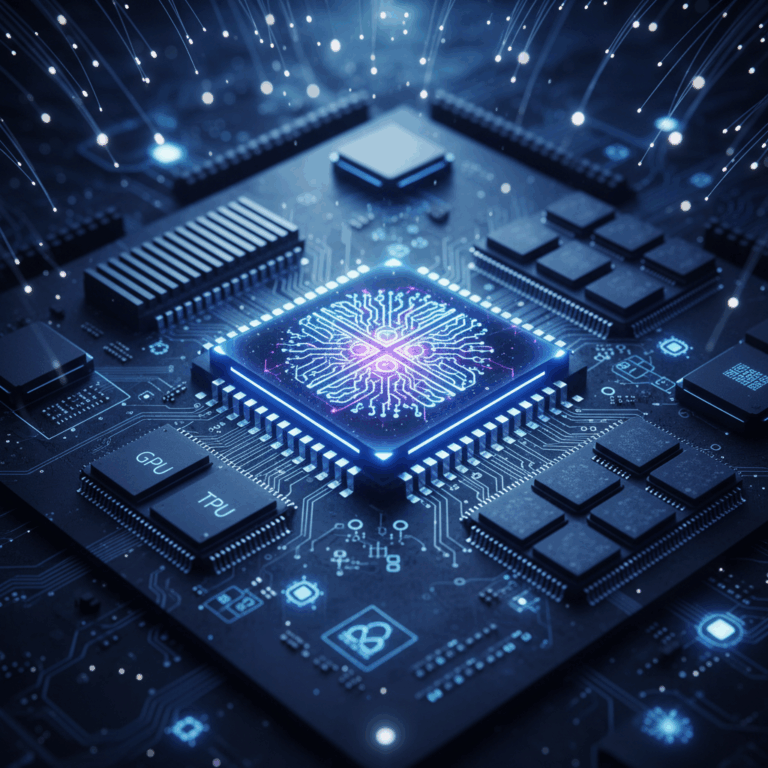
Hardware basics for AI
Hardware for artificial intelligence is essential for running complex machine learning algorithms and neural networks. It is designed to handle intensive and parallel calculations.
Among the main devices for AI, GPUs and TPUs stand out, each with specific characteristics that make them ideal for different types of tasks in artificial intelligence.
Role of GPUs in artificial intelligence
The GPU they were initially created to process graphs, but their architecture allows calculations to be carried out in parallel, accelerating the training of AI models.
With thousands of cores, GPUs handle large volumes of data and mathematical operations, being key to deep learning tasks and business applications.
Their versatility and robust ecosystem make them the favorite option for development and implementation in various technological sectors.
Features and advantages of TPUs
The TPU, developed by Google, are specifically designed to optimize tensor operations in neural networks, increasing efficiency and speed.
These units perform deep learning tasks with lower power consumption and reduced training times compared to traditional GPUs.
Their specialization makes them ideal for high-volume loads in cloud services, offering superior performance in very specific scenarios.
Type of chips dedicated to AI
Dedicated AI chips are designed to optimize specific machine learning processes and neural networks. Their specialization improves efficiency and performance in limited environments.
These components allow complex tasks to be executed with lower power consumption, which is essential for applications on mobile devices and edge systems.
Custom chips and NPU
Custom chips and Neural Processing Units (NPUs) are made to replicate the structure and function of the human brain in hardware.
NPUs are optimized for inference acceleration and training, offering superior performance in neural calculations compared to conventional processors.
Additionally, these chips enable latency reduction and greater power efficiency, vital in physically or power-constrained applications.
Applications on edge and mobile devices
Edge and mobile devices benefit from dedicated AI hardware thanks to their low consumption and speed in local data processing.
This makes it easy to develop applications such as facial recognition, voice assistants and augmented reality, without relying on constant connectivity to the cloud.
Integrated hardware improves privacy and reduces latency, providing more efficient and secure user experiences in mobile environments.
Key developers and manufacturers
Leading companies such as NVIDIA, Google and Qualcomm are at the forefront of developing custom AI chips and NPU solutions.
These companies design hardware adapted to different platforms, from data centers to mobile devices, driving market evolution.
Its constant innovation drives new specialized architectures that improve the performance and efficiency of hardware for artificial intelligence.
Comparison between GPU, TPU and dedicated chips
Efficiency and performance in specific tasks
The GPU they excel in parallel calculations and general model training, offering flexibility but with greater energy consumption.
The TPU they are optimized for tensor operations, achieving greater speed and efficiency in specific deep learning.
Dedicated chips, such as NPU, shine in inference and real-time applications with high efficiency and low consumption on mobile devices.
Uses according to the platform and objectives
The GPU they are widely used in research and data centers for their versatility and ability to handle multiple tasks.
The TPU they are preferred in specialized cloud environments, where optimization of tensile loads is critical to performance.
Dedicated chips are designed for edge and mobile devices, prioritizing power efficiency and low latency for specific applications.
Impact and trends of hardware in AI
Specialized hardware drives the development of intelligent systems by improving the speed and efficiency of complex AI processes. This is crucial to advancing areas such as robotics and automation.
The evolution of AI hardware defines new capabilities for advanced applications, enabling faster, more accurate and energy-efficient solutions in multiple technology sectors.
Importance in the development of intelligent systems
AI hardware is the foundation for building intelligent systems that can learn, adapt and make decisions in real time more quickly and accurately.
This is especially important in critical applications such as computer vision or language processing, where hardware efficiency determines system performance.
Therefore, the advancement in GPUs, TPUs and dedicated chips is a decisive factor in exploiting the full potential of artificial intelligence in practice.
Future and segmentation of the AI hardware market
The AI hardware market tends to strongly segment according to types of devices and applications, favoring the specialization of chips for specific tasks.
The coexistence of custom GPUs, TPUs, and accelerators is expected to continue, each optimized for different environments such as cloud, edge, or mobile.
Additionally, the growing demand for energy efficiency and low latency promotes continuous innovations, expanding the variety and capacity of AI processors.