Fundamentals of multimodal models
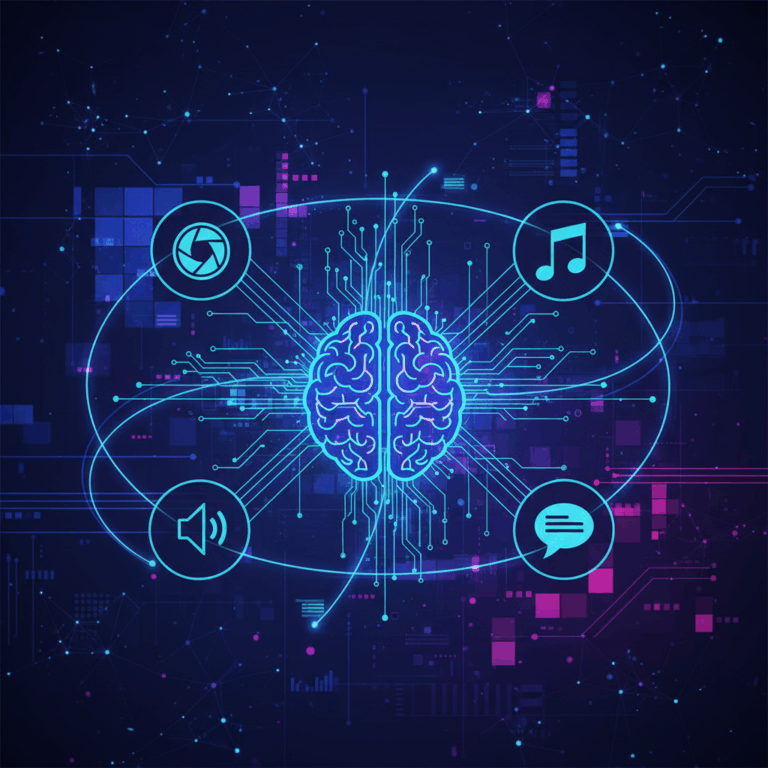
The multimodal models they represent an evolution in artificial intelligence by integrating data from various sources such as text, images, audio and video. This allows for a more complete understanding of the context.
Unlike traditional models that work with a single type of data, these models merge information to achieve more precise and natural interpretations, approaching human reasoning.
Definition and main characteristics
Multimodal models combine different modalities of information to process heterogeneous data together. This capability allows them to perform complex tasks that require integrated analysis.
They stand out for their ability to synthesize text, images and other formats, facilitating interactions that take advantage of multiple sources and generating more contextual and complete responses.
Its design seeks to overcome limitations of one-dimensional models, offering artificial intelligence with greater versatility and adaptability to real situations.
Operation based on deep learning architectures
These models use advanced architectures deep learning, especially multimodal transformers, which use attention mechanisms to merge representations of different data.
They use shared embeddings that convert various modalities into a unified vector space, facilitating the identification of semantic relationships between texts, images and sounds.
For example, they can simultaneously analyze an image and its description to generate content or coherent responses, combining generative and understanding capabilities.
Current applications and featured examples
Multimodal models are revolutionizing different industries thanks to their ability to process multiple types of data simultaneously. This technology allows for smarter and more contextual solutions.
Its impact extends to sectors such as medicine, education and commerce, offering tools that integrate images, texts and sensory data to improve results and optimize processes.
Recognized models such as GPT-4 and Gemini
Models like GPT-4 and Gemini they stand out for their ability to understand text and images in a conversation, achieving more natural and information-rich interactions.
These platforms use advanced multimodal architectures that allow them to generate complete responses, analyze associated images, and offer solutions applicable to multiple domains.
Its flexibility facilitates integration into practical applications, from virtual assistants to complex analysis systems, demonstrating the versatility of this technology.
Impact on fields such as medicine, education and commerce
In medicine, multimodal models allow medical images to be interpreted along with clinical reports to improve personalized diagnoses and treatments.
In education, they enhance adaptive systems that combine text, video and audio to offer more effective and dynamic learning experiences.
In commerce, they provide intelligent recommenders that analyze reviews, product images and consumer contexts to optimize sales and customer satisfaction.
Practical examples of multimodal use
An example is the joint analysis of photographs and textual descriptions to generate summaries or automatic recommendations on online platforms.
Multimodal models are also used in surveillance systems that relate video recordings to described events to improve real-time security.
Likewise, virtual assistants that include voice and visual commands guide users with integrated and personalized responses, increasing efficiency and usability.
Recent trends in multimodal models
Multimodal models are rapidly evolving toward integrating multiple types of data, increasing their ability to understand complex contexts in real time.
This evolution allows for increasing precision and more sophisticated applications, adapting to the demands of varied business and social sectors.
Integration of multiple types of data and greater precision
Currently, the continuous integration of data such as audio, video and sensory signals is emphasized, expanding the spectrum of information processed simultaneously.
Combining these sources into multimodal models allows for finer, more accurate analyses, thanks to deeper architectures and efficient cross-attention mechanisms.
This advance improves contextualization, enabling models that capture more complex dynamics and subtleties in human-machine interaction.
Foundational models and business applications
Multimodal foundational models form the basis for developing specialized solutions in industrial sectors such as finance, healthcare and retail.
These general models ensure scalability and adaptability, making it easier to create specific tools for complex business problems.
Its use allows companies to analyze vast volumes of multi-modal information to optimize processes, improve decision making and enhance innovation.
Advanced generative capabilities
State-of-the-art generative capabilities enable the simultaneous creation of text, images, audio and videos from various combinations of input data.
This versatility drives new forms of personalized content and creative assistance, expanding the reach of artificial intelligence in areas such as art, marketing and entertainment.
Thus, multimodal models move towards a more comprehensive and coherent generation of content, responding to more complex and multidimensional needs.
Future and perspectives of multimodal models
Multimodal models are transforming the way machines understand and respond to the world, becoming increasingly integrated into our daily lives.
Its evolution promises intelligent virtual assistants capable of interacting naturally, improving the human experience and efficiency in various areas.
Evolution towards intelligent virtual assistants
Multimodal virtual assistants will increasingly be able to interpret multiple types of information, such as voice, text, images and gestures, to provide more accurate responses.
This will facilitate more natural and contextual interactions, where the assistant better understands the user's needs and anticipates actions.
Additionally, combining data will enable deep personalization, dynamically adapting to individual context and preferences in real time.
Digital transformation and new human-machine interactions
The integration of multimodal models is driving a revolution in digital transformation, enabling more intuitive and efficient interfaces between humans and machines.
This leads to new forms of interaction that combine natural language, images and other senses, facilitating complex tasks and supporting decision making.
Likewise, these technologies are opening the way to immersive and collaborative experiences, where communication will be more fluid and multidimensional.