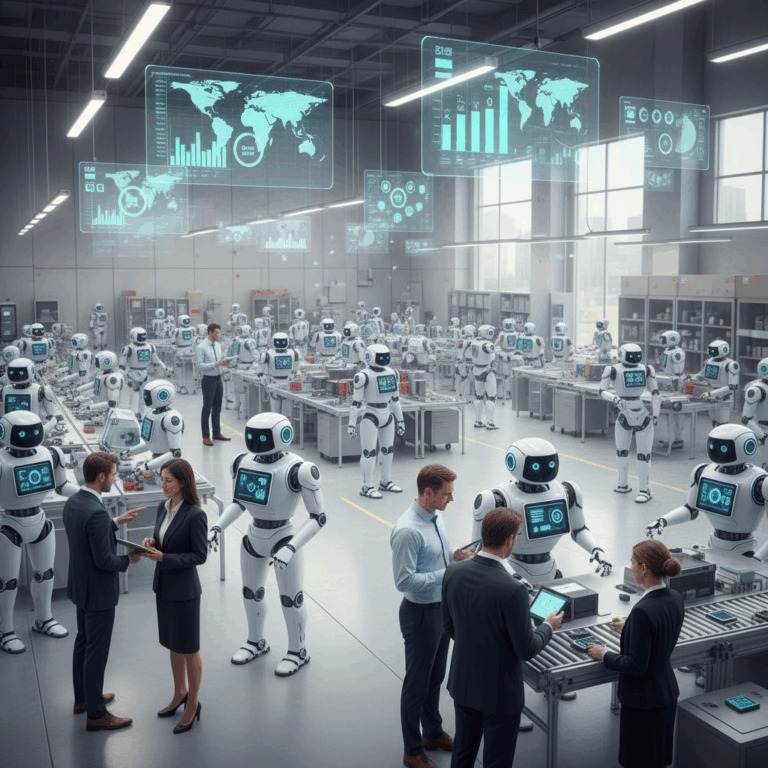
Robotic transformation in industry and commerce
The robotic transformation in industry and commerce it is revolutionizing processes with automation and advanced artificial intelligence. This evolution redefines productivity and efficiency.
Enterprise robots now have the capabilities to adapt and collaborate in real time, providing greater security and flexibility. This positively impacts various industrial and commercial sectors.
The integration of robotic technologies is facilitating dynamic interaction with the work environment, optimizing tasks from manufacturing to customer service, and creating new business opportunities.
Innovations in artificial intelligence applied to robots
Artificial intelligence applied to robots allows them to perceive and respond to their environment autonomously, overcoming the rigidity of traditional machines.
Current advances include multi-agent systems that collaborate with each other and with humans to manage complex flows and improve decision making in real time.
This integrated intelligence transforms robots into strategic partners that can adjust to unexpected changes, increasing efficiency without sacrificing job security.
Pioneering examples: Gemini Robotics and its capabilities
Gemini Robotics, launched by Google DeepMind in 2025, is an example of innovation that combines advanced AI to deliver adaptability and dynamic collaboration.
Unlike traditional robots, Gemini can detect obstacles, work alongside humans and adjust its actions in real time, being useful in factories and commercial environments.
Its capabilities allow improving both safety and productivity, marking a before and after in robotic application within industry and global commerce.
Key applications in business sectors
Enterprise robots have transformed multiple sectors, optimizing processes and improving productivity with advanced technologies.
Its incorporation changes everything from logistics to the automotive industry, increasing efficiency and collaboration with humans.
This technological revolution allows companies to compete better, reduce costs and increase safety in the work environment.
Robots in logistics and distribution: Amazon case
Amazon has integrated advanced robots into its fulfillment centers to speed up order picking and shipping.
Mobile robots and automated arms work together, improving precision and reducing times, increasing operational capacity.
Additionally, these systems reduce occupational risks by limiting human exposure to repetitive and dangerous tasks.
Automation in the automotive industry
Manufacturers such as Ford and Tesla use robots for assembly and painting, combining speed with high precision on production lines.
Automation protects workers, preventing exposure to toxic substances and dangerous procedures.
This reduces costs and facilitates scalability, maintaining high standards of quality and manufacturing safety.
Collaborative robots (cobots) and their impact on human work
Cobots work alongside employees, assisting in repetitive tasks without the need for safety barriers.
Its presence allows workers to focus on more complex and creative activities, improving added value.
It is expected that in the next decade more than 90% of companies will adopt this technology to optimize their work processes.
Multi-agent systems and advanced cooperation
Multi-agent systems allow robots and virtual agents to cooperate to handle complex workflows.
This cooperation improves organizational management, anticipating needs and adjusting decisions in real time.
Innovation in collaborative artificial intelligence
These systems represent a leap towards robots that not only automate, but act as strategic partners in business environments.
Benefits of robotic integration
The integration of robots in companies provides multiple benefits that transform the way of working. Mainly, it focuses on improving productivity and operational efficiency.
Furthermore, automation using robots reduces errors and downtime, generating more agile and reliable processes. This has a direct impact on business competitiveness and profitability.
On the other hand, the incorporation of robots also has a positive impact on occupational safety, by minimizing risks and protecting workers in dangerous or repetitive tasks.
Improvement in productivity and operational efficiency
Business robotics allows you to optimize production processes, increasing the speed and precision in the execution of tasks. This reduces costs and operational errors.
Advanced robots, such as those from Gemini Robotics, adapt their actions in real time, eliminating waiting times and improving coordination on production lines.
Automation also facilitates inventory and order management, accelerating logistics flow and increasing the operational capacity of companies like Amazon.
Increased job security and risk reduction
Using robots in high-risk tasks reduces employees' exposure to hazardous environments or repetitive jobs that can lead to injuries.
Cobots collaborate safely with humans, avoiding accidents and improving working conditions in industrial plants.
Additionally, constant monitoring and real-time adaptation of these systems prevent failures that could pose a danger to personnel.
Trends and future of business robots
The future of business robots is projected to be highly marked by the mass adoption of cobots in multiple sectors.
This trend will be key to promoting efficiency and collaboration between humans and machines, transforming work environments.
Furthermore, the integration of robots as strategic partners will revolutionize business decision-making thanks to advanced artificial intelligence.
Projection of mass adoption of cobots
It is expected that in the next decade more than 90% of companies incorporate cobots into your production and logistics processes.
These collaborative robots facilitate flexible automation without replacing the human worker, promoting efficient joint work.
The adoption of cobots will allow employees to focus on higher-value tasks, while robots handle repetitive and heavy activities.
This accelerated growth is driven by cost reduction and improved ability to adapt to changing environments.
Robots as strategic partners in decision making
Robots with artificial intelligence not only automate but also act as key allies in business decision processes.
These systems can analyze large volumes of data in real time to deliver accurate recommendations and timely opportunities.
Thanks to cooperation between robots and humans, risks can be anticipated, resources optimized and market changes responded quickly.