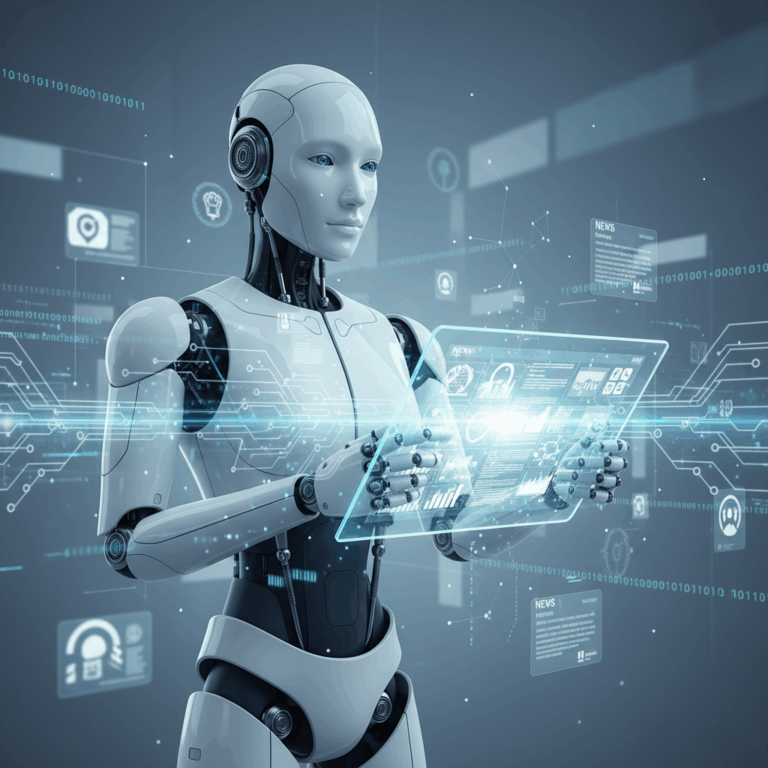
Integration of AI in robotics in 2025
In 2025, the integration of the artificial intelligence (AI) in robotics it has reached a crucial point, where robots no longer only perform repetitive tasks.
Now, they are machines capable of learn, adapt and make decisions in dynamic and complex environments, thus improving their autonomy and functionality.
These advances enable seamless collaboration between humans and robots in various fields, expanding applications in everyday life and industry.
Advances in autonomy and capabilities of robots
The autonomy of robots has been increased thanks to the ability of AI to process large volumes of data and extract useful knowledge.
Modern robots perform tasks advanced planning, pattern recognition and predictive maintenance, responding in real time to environmental changes.
This evolution allows robots to operate without constant supervision, making their decisions more flexible and increasing efficiency in multiple sectors.
Applications in industrial, healthcare and domestic environments
Intelligent robotics is applied in industry to optimize manufacturing and logistics, improving productivity and safety.
In the healthcare field, it contributes to the surgical robotics and personal assistance systems, providing personalized and precise care.
At the domestic level, robots increase their autonomy to perform daily tasks, adapting to individual needs and family environments.
Emerging technologies in intelligent robotics
Intelligent robotics is advancing rapidly thanks to the integration of emerging technologies that enhance the cognitive and physical abilities of robots.
These developments allow robots to perform complex tasks, improving their interaction and collaboration in various fields.
Advances in AI have led to more precise, efficient and adaptive robots, transforming multiple productive and social sectors.
Hyperintelligent robots and complex problem solving
Hyperintelligent robots possess the ability to solve complex problems through deep learning and real-time analysis.
Their ability to understand natural language and process large volumes of data makes them ideal for advanced cognitive tasks.
This intelligence allows them to adapt to unforeseen scenarios, optimizing decisions without constant human intervention.
Surgical robotics, exoskeletons and robotic swarms
Surgical robotics offers unmatched precision, improving results and reducing risks in complex medical interventions.
Exoskeletons enhance human mobility, facilitating rehabilitation and increasing physical capabilities in specific jobs.
Robotic swarms coordinate multiple units for joint actions, excelling in rescues and operations in hostile environments.
Interesting fact about robotic swarms
These swarms are inspired by nature, imitating insect collectives, to achieve efficient coordination and adaptation in real time.
Mobile robotics and real-time decision making
Mobile robotics has reached an advanced level, where robots make quick and accurate decisions in dynamic environments.
Thanks to advanced sensors and AI, they can navigate and act without supervision, improving logistical and care processes.
This autonomy allows robots to be deployed in complex scenarios, such as hospitals or warehouses, with great efficiency and safety.
Challenges and ethical considerations
The advancement of artificial intelligence in robotics poses important challenges related to security and ethics.
Robot autonomy requires effective human oversight to ensure their decisions are safe and accountable.
Furthermore, it is essential to analyze the ethical implications that arise when integrating AI into machines capable of acting autonomously.
Safety and human supervision in autonomous decisions
The increasing autonomy of robots implies potential risks that require constant human supervision to prevent errors.
Safety protocols are established to control autonomous decisions, ensuring that robots act in accordance with ethical and legal standards.
The interaction between humans and robots demands systems that allow rapid intervention in case of failures or unexpected behaviors.
Ethical implications of artificial intelligence in robotics
The use of AI in robotics raises ethical dilemmas about the responsibility of actions taken by autonomous machines.
It is necessary to define clear limits to avoid decisions that may negatively affect individuals or groups.
Furthermore, transparency and respect for privacy are key aspects in the responsible development of these technologies.
Social impact and future of human-robot collaboration
Collaboration between humans and robots is profoundly transforming society, improving efficiency in multiple areas such as work and health.
The future of this interaction promises even smoother integration, where intelligent robots expand human capabilities and foster new forms of cooperation.
This advance also raises important social and ethical questions that must be addressed to maximize benefits and minimize risks.
Transformation in work and healthcare
Intelligent robotics is revolutionizing the world of work, automating repetitive tasks and freeing humans for creative and strategic activities.
In the healthcare sector, robots offer more precise care, constant monitoring and support in surgeries, improving the quality of life of patients.
This transformation also implies the need for specialized training so that workers can adapt to collaboration with advanced machines.
Revolution in the interaction between humans and machines
Human-robot interaction evolves into natural dialogue, thanks to capabilities such as language recognition and emotional understanding.
Collaborative robots are already part of everyday life, from personal assistants to colleagues in work environments, increasing productivity and well-being.
This revolution encourages new forms of joint work, where synergy enhances both human performance and robotic functionality.