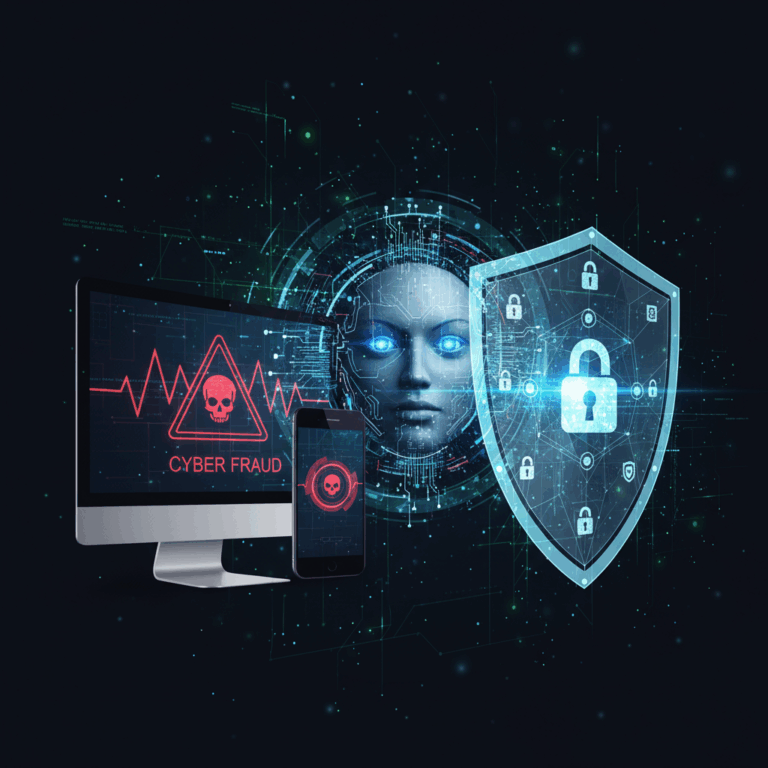
The role of AI in digital security
Artificial intelligence (AI) plays a crucial role in the digital security, automating processing to detect and respond to threats. Its ability to handle big data makes it indispensable.
Thanks to advanced algorithms, AI not only identifies risks, but also improves efficiency in incident management, helping to protect systems and users in real time against complex attacks.
Automated threat detection
AI allows automated detection and continued threats in digital environments, identifying potential attacks before they cause significant damage. This speeds up the reaction to incidents.
By constantly analyzing suspicious activity, AI-based systems can alert and block unauthorized access, maintaining the integrity and confidentiality of protected data.
This approach reduces the need for manual intervention, increasing accuracy and decreasing response time to new, rapidly evolving attack methods.
Analysis of data and abnormal patterns
AI examines large volumes of data to detect abnormal patterns which could indicate fraud or intrusions, identifying subtle differences that escape the human eye.
These analytics systems help anticipate malicious behavior, enabling a proactive response before significant damage or loss occurs.
Additionally, machine learning continually improves these analytics, adapting to new threats and optimizing accuracy in identifying digital risks.
Specific applications of AI in cybersecurity
AI has specific applications in cybersecurity, from identifying threats to optimizing responses. Its versatility provides an intelligent approach to protecting systems.
These applications allow you to detect malware, prevent fraud and manage incidents efficiently, mitigating risks and strengthening defense against sophisticated and growing attacks.
Additionally, AI helps reduce false positives and facilitates scalability in security management, improving productivity and optimizing resources in complex digital environments.
Identification of malware and anomalies
AI detects malware by analyzing unusual data and behavior, identifying malicious software before it causes significant damage.
Thanks to machine learning models, the system continually learns to recognize new malware variants and suspicious patterns, increasing their effectiveness over time.
This proactive approach improves early detection and prevents attacks that use advanced techniques to evade traditional security systems.
Fraud prevention and incident management
AI facilitates fraud prevention by analyzing transactions and activities in real time, detecting irregularities that suggest fraudulent behavior.
It also automates incident management through quick alerts and data-driven strategic recommendations, optimizing the response of security teams.
This capability reduces the impact of incidents, minimizes economic losses, and strengthens control over systems protected against emerging threats.
False positive reduction and scalability
With AI, cybersecurity systems reduce the number of false positives, avoiding unnecessary alerts that consume time and human resources.
In addition, technology facilitates scalability in digital protection, allowing large volumes of data and simultaneous threats to be managed without losing effectiveness.
This is key for companies and organizations that need to maintain high security standards in the face of an increasingly dynamic and complex digital environment.
The risks of AI use by scammers
Artificial intelligence not only strengthens security, but can also be exploited by scammers to develop more sophisticated techniques that trick users and systems.
This malicious use of AI presents increasing risks, making fraud detection and prevention difficult, and requires advanced strategies to counter these threats.
Improved AI scammer tactics
Scammers use AI to automate attacks and create personalized messages that increase the effectiveness of their frauds, making their tactics more difficult to identify.
Additionally, AI enables targeted phishing and large-scale social engineering attacks, leveraging data analytics to better target potential victims.
These advanced practices make the work of security systems difficult, which must constantly adapt to detect increasingly sophisticated techniques.
Deepfakes and fake profiles
The creation of deepfakes is a significant threat, as it allows the generation of false audiovisual content that manipulates victims with great realism, increasing the potential for fraud.
Likewise, fake profiles generated by AI on social networks create deceptive identities that facilitate the recruitment and scam of unsuspecting users through simulated trust.
These tools increase the risk of spoofing and misinformation, requiring continued attention and new measures to detect and mitigate these threats.
Strategies to leverage AI effectively
To maximize the benefit of artificial intelligence in digital security, it is vital to implement strategies that combine advanced technology with expert collaboration. This guarantees a solid and adaptive defense.
Using AI responsibly and effectively requires organizations to take clear preventive measures and foster partnerships with cybersecurity professionals to address complex threats.
Preventive measures and professional collaboration
Take preventive measures how constant system updating and digital security training strengthens the use of AI against sophisticated and emerging attacks.
Collaboration between experts and technological teams is essential to interpret data generated by AI, accurately detecting threats and optimizing rapid and effective responses.
Additionally, sharing information about cyber incidents between organizations creates a more robust security ecosystem, where AI can learn and adapt to new vulnerabilities.
Technological integration and human experience
The integration between technology AI and human experience is key to making the most of the potential of this cybersecurity tool, combining automated analysis with critical judgment.
Specialists provide context and criteria that AI cannot replicate, interpreting results and deciding appropriate actions in the face of complex or uncertain scenarios.
This hybrid approach improves efficiency and reduces errors, allowing for constant monitoring and dynamic adjustments to digital protection strategies.