Advantages and limits of AI in text correction
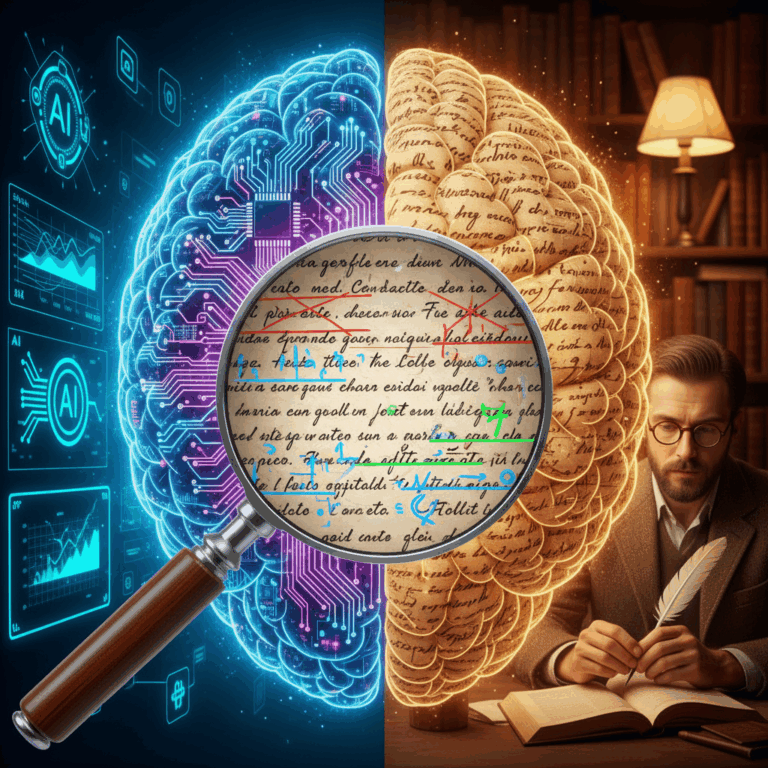
The artificial intelligence it has revolutionized textual correction, offering fast and efficient detection of basic errors. Its analysis capacity exceeds human speed in repetitive tasks.
However, the AI has limitations important for capturing complex aspects of language, such as personal style and cultural details, that require deep interpretation.
Therefore, it is essential to understand both its benefits and its borders to make the most of this technology in text correction.
Speed and precision in detecting basic errors
AI stands out for its speed in identifying grammatical and spelling errors with great precision. This allows large volumes of text to be corrected in a short time, increasing productivity.
Additionally, it adapts its suggestions based on the type of text and audience, providing contextual recommendations that enrich the basic review. Your continuous learning improves your performance over time.
These characteristics make AI a valuable tool for technical tasks, where accuracy and speed are a priority.
Limitations in the interpretation of nuances and style
Although AI processes data efficiently, it fails to fully interpret it emotional nuances or personal style of the text. This affects the quality of corrections in subjective aspects.
Human proofreaders can capture metaphors, idioms, and cultural subtleties that AI does not yet understand, ensuring an authentic and coherent message.
Consequently, AI cannot completely replace the expert gaze and sensitivity that human professionals bring to literary and creative correction.
Comparison between AI and human reviewers
The AI offers technical capabilities advanced that allow you to quickly adapt to various types of text. His ability to analyze grammatical norms and syntactic structures is exceptional.
For their part, human reviewers provide a flexible vision that considers the global context, showing greater understanding of texts with complex or creative nuances.
This combination highlights the fundamental difference between computational speed and specialized human interpretation.
Technical capabilities and adaptation to the type of text
AI can recognize common patterns and errors in various textual genres in an automated way. Their constant learning improves accuracy in technical and formal texts.
In addition, it adapts according to the expected register and style, adjusting suggestions that fit the target audience. This represents a great advance in versatility compared to previous tools.
However, some literary styles or creative texts may challenge algorithms for their inherent complexity and ambiguity.
Cultural and creative sensitivity of human reviewers
Human proofreaders recognize cultural nuances and personal styles that AI cannot fully interpret. His experience allows us to capture the author's more subtle intentions.
Likewise, they can assess the emotional and expressive adequacy of the text, suggesting adjustments that preserve the writer's voice and originality.
This sensitivity is key in the correction of literary, advertising or culturally intense texts.
Advantages and complementary deficiencies
While AI is fast and efficient at objective corrections, its lack of social and creative judgment limits its overall autonomy. Human reviewers bring depth and judgment.
Therefore, both resources complement each other: AI lightens loads and offers precision, and humans guarantee coherence and communicative richness.
This balance enhances the final quality, demonstrating that human-machine integration is the most effective way currently.
Importance of the hybrid approach in textual correction
The hybrid approach combines the speed and precision of AI with the sensitivity and judgment of human proofreaders. This collaboration optimizes the quality of the final text.
AI is responsible for detecting technical errors quickly, while humans evaluate style, coherence and nuances, aspects that require deep understanding.
Thus, this model takes advantage of the best of both capabilities, achieving efficient and respectful corrections with the author's intention.
Combined contribution of AI and human correctors
The AI performs efficient initial work, correcting basic spelling and grammatical errors very quickly, saving human proofreaders time.
Human proofreaders, on the other hand, provide a critical look that detects cultural, stylistic and creative aspects, which AI cannot yet interpret.
Your intervention guarantees that the text maintains its original voice and deep coherence, essential elements for a comprehensive correction.
This collaboration allows AI and the human corrector to work in synergy, improving efficiency and quality at the same time.
Future perspectives and recommendations
The continuous advancement of the artificial intelligence it promises to further improve text correction efficiency through more sophisticated algorithms and machine learning.
Incorporating AI into workflows will allow quick corrections to be made without sacrificing adaptation to the context, facilitating the production of content with greater volume and quality.
Potential of AI to improve efficiency
AI can automate repetitive tasks and detect basic errors quickly, optimizing review time and reducing costs on editorial or educational projects.
Your ability to learn from previous corrections helps refine suggestions, making the process increasingly effective and personalized.
This opens the door to combining its capabilities with other technologies, such as advanced natural language processing, to expand its reach.
Relevance of human criteria for final quality
Although AI improves efficiency, the ultimate quality of a text depends on the human critical sense, which values cultural context, author's intentions and style.
Human proofreaders interpret subtleties and adapt corrections to preserve the writer's unique voice, offering a level of refinement that AI has yet to achieve.
Therefore, human review remains essential to ensure coherence, creativity and precision in complex or emotional content.