Professions that integrate artificial intelligence
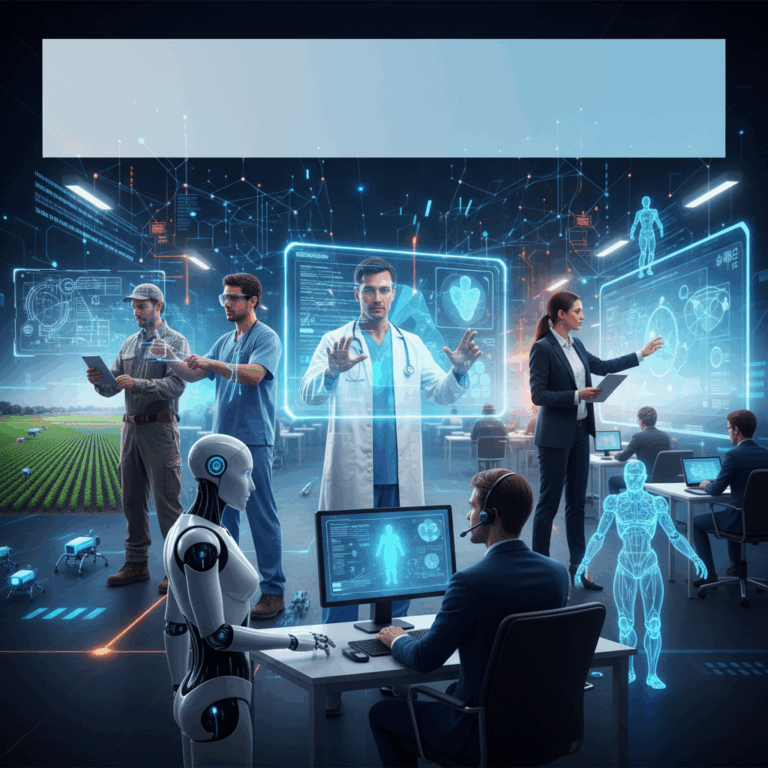
The integration of the artificial intelligence in various professions it is revolutionizing the way tasks are carried out, increasing efficiency and precision in different sectors.
Professionals from multiple areas use AI to optimize processes, analyze complex data and make better-informed decisions, driving a profound transformation in their daily activities.
This change not only improves performance, but also creates new job opportunities and specializations focused on the development and ethical use of technology.
Use of AI in the health sector
In the healthcare sector, AI is used to support diagnosis by analyzing medical images and clinical data, improving accurate detection of diseases. This allows for more effective and personalized interventions for patients.
Doctors and healthcare professionals integrate machine learning algorithms to develop individualized treatment plans, optimizing outcomes and reducing human error.
Additionally, AI analyzes large volumes of medical data to identify relevant patterns, facilitating research and advances in healthcare globally.
Applications of AI in finance
In the financial field, AI is used to detect fraud and evaluate risks with a capacity greater than human capacity, allowing asset protection and transaction security.
Algorithms quickly process large volumes of financial information, giving analysts tools to make more informed and agile decisions in investments and portfolio management.
This transforms the way financial institutions operate, increasing accuracy in predicting markets and optimizing their financial strategies.
Impact of AI on manufacturing and industry
Artificial intelligence is revolutionizing manufacturing and industry by introducing advanced technologies that increase efficiency. Automation drives productivity and transforms traditional processes.
Industrial companies adopt intelligent systems to optimize operations, reduce costs and improve the quality of their products. This creates a more dynamic and precise work environment.
AI also facilitates strategic decision making based on real-time data analysis, strengthening the competitiveness of the industrial sector in the global market.
Automation and robots in production
Intelligent robots and automated systems, guided by AI, perform repetitive tasks with great precision. This decreases human wear and tear and increases production speed without sacrificing quality.
Automation allows production lines to operate 24/7, improving production capacity and allowing rapid response to market demands.
In addition, AI facilitates the integration of robotic systems with other industrial processes, creating more flexible and adaptive production chains.
Optimization and error reduction
Artificial intelligence identifies patterns and anomalies in production processes, allowing early detection of failures and significant reduction of errors.
This improves the final quality of products and reduces waste, contributing to more sustainable and profitable manufacturing for companies.
Likewise, AI optimizes predictive maintenance of machinery, avoiding unexpected stops and prolonging the useful life of industrial equipment.
Professionals specialized in artificial intelligence
Professionals specialized in artificial intelligence play a fundamental role in the development, implementation and management of intelligent technologies that transform industries and businesses.
These experts combine advanced technical knowledge with complex problem-solving skills, ensuring AI systems operate effectively and responsibly.
His work not only drives innovation, but also faces ethical and social challenges, being key to the correct and beneficial use of artificial intelligence.
Data engineers and AI developers
Data engineers prepare and manage large volumes of information, essential for training AI models that developers then apply to create intelligent solutions.
These professionals design algorithms and systems that automate tasks, improve processes and generate value in sectors such as health, finance and manufacturing, among others.
Their work requires a deep command of programming, statistics and machine learning, as well as the ability to adapt technologies to specific needs.
AI Ethics Specialists
AI ethicists ensure the responsible and fair use of artificial intelligence, analyzing risks and proposing regulations to avoid bias and discrimination.
They work to ensure that AI systems respect human rights and ethical principles, addressing concerns about privacy, transparency and accountability.
Its role is increasingly crucial, given the social impact that AI has, ensuring that its development benefits society without causing unintended harm.
New job opportunities and challenges with AI
The arrival of the artificial intelligence it is causing a profound transformation in the labor market, generating both new opportunities and challenges for various professions.
Traditional professions must adapt to a changing technological environment, integrating AI tools to maintain their relevance and competitiveness in their respective fields.
At the same time, new roles emerge that require specialized skills in programming, data analysis, and ethical management of intelligent systems.
Evolution of traditional professions
Classical professions are undergoing significant evolution, as AI automates repetitive and complex tasks, allowing professionals to focus on strategic activities.
For example, doctors and lawyers now use AI-based systems to support legal diagnoses and analysis, streamlining processes and raising the quality of their services.
This transformation requires constant updating of knowledge and greater technological integration in vocational training to avoid obsolescence.
Creation of new roles and skills
The introduction of AI drives the creation of new job profiles as AI engineers, data scientists and technology ethicists, roles that did not exist a few years ago.
Furthermore, soft skills such as critical thinking and the ability to continuously learn are essential to adapt to these new positions in a digital environment.
Importance of continuous training
Continuous training is essential so that professionals can acquire and update skills related to AI and its practical application in different sectors.
Investing in technological and ethical education will allow us to successfully face the challenges posed by the integration of artificial intelligence in the labor market.