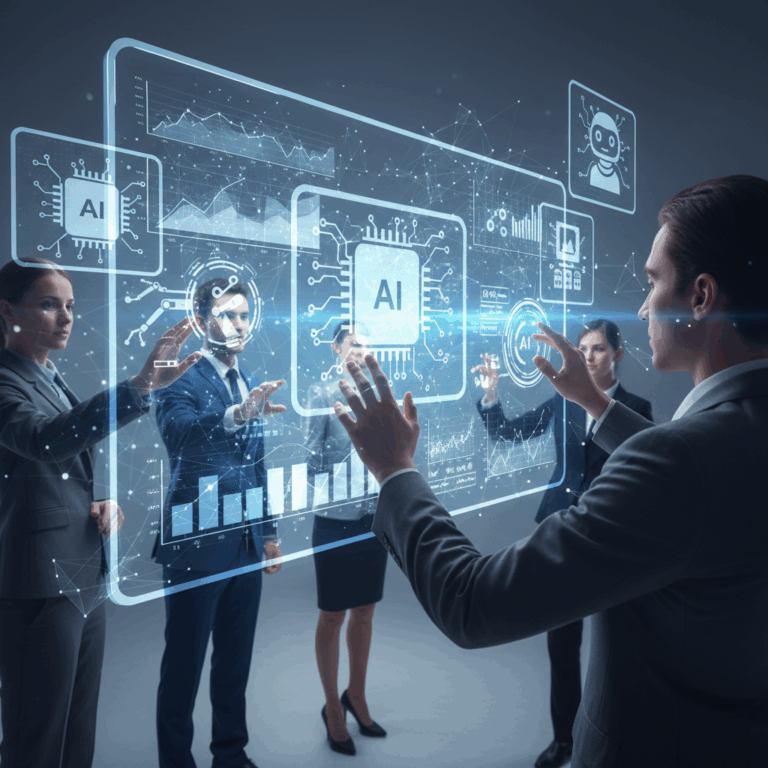
Transformation of AI in the business world
In 2025, artificial intelligence revolutionizes the business world, driving profound transformation. AI becomes the central driver for automation and innovation.
This technological evolution allows companies to manage resources more efficiently and anticipate needs, taking sustainability and competitiveness to a new level.
The mass adoption of AI solutions is marking a before and after in the way businesses operate and adapt to ever-changing dynamic markets.
Advanced automation with AI agents
AI agents are revolutionizing automation by not only executing tasks, but also making complex decisions autonomously in real time.
These intelligent tools allow you to optimize processes, reduce errors and increase productivity, supporting efficient management in all types of industries.
By anticipating and responding to business needs, AI agents help companies maintain a sustainable competitive advantage in demanding markets.
Adoption of AI by large Fortune 500 companies
Almost the 70% of Fortune 500 companies they have integrated AI tools such as Microsoft 365 Copilot to improve the automation of their internal processes.
This mass adoption confirms how artificial intelligence is key to raising efficiency, driving innovation and achieving better business results.
Large corporations are leveraging AI to transform critical areas, from operations to customer service, consolidating their global leadership.
Impact of AI in key business areas
Artificial intelligence is transforming fundamental aspects of business operations, impacting efficiency and innovation. In 2025, companies are discovering new ways to integrate AI to boost their results.
From improving customer experience to optimizing supply chains, AI offers important competitive advantages across sectors, making businesses more agile and profitable.
Additionally, security and real-time decision making are strengthened thanks to intelligent systems that proactively respond to threats and changes in the global market.
Improving customer experience
AI algorithms allow you to personalize care and services, adapting to the specific needs of each user, which significantly improves satisfaction and loyalty.
Companies can now anticipate demands and deliver solutions in real time thanks to intelligent analysis of behavioral data and individual preferences.
This digital transformation favors more fluid communication, increasing speed and precision in customer service, a key aspect in highly competitive markets.
Supply chain optimization
AI facilitates efficient supply chain management, automating critical processes and reducing operating costs, delivery times and waste.
Through predictive analysis, companies can anticipate demand, optimize inventories and improve logistics, achieving greater flexibility in the face of market fluctuations.
This evolution generates a direct impact on reducing losses and improving service quality, strengthening the global competitiveness of the business.
Decision making based on real-time data
AI provides advanced tools to process large volumes of data quickly, facilitating accurate and timely decisions in complex business environments.
Immediate access to updated information allows managers to respond quickly to opportunities and risks, adapting strategies according to market trends.
This data-driven approach improves operational efficiency and enhances innovation, ensuring companies remain relevant and competitive.
Smart cybersecurity
AI solutions strengthen the protection of data and enterprise systems through early threat detection and automated responses to security incidents.
These intelligent systems constantly learn and adapt to face increasingly sophisticated cyber attacks, protecting the integrity of information.
AI-based cybersecurity is essential to maintain the trust of customers and partners, ensuring operational continuity and avoiding significant losses.
AI opportunities for small and medium-sized businesses
Small and medium-sized enterprises (SMEs) are taking advantage of artificial intelligence to improve their competitiveness in increasingly demanding markets. AI offers tools that were previously only available to large corporations.
These accessible technologies allow SMEs to optimize their operational efficiency and make decisions based on data, which translates into greater profitability and capacity for innovation.
The application of AI solutions facilitates key processes, helping these companies differentiate themselves and grow in their market niche through intelligent use of available resources.
Improved competitiveness and efficiency
AI helps SMEs optimize resources and reduce costs, achieving more agile and efficient processes. This translates into faster responses to market demands and better customer service.
By automating routine tasks, teams can focus on innovation and generating added value, which increases competitiveness against larger companies.
In addition, AI-based platforms allow you to implement personalized strategies and adapt to trends more quickly, strengthening your position in dynamic sectors.
Automation and analysis of accessible data
AI solutions are increasingly available to SMEs, facilitating the automation of repetitive processes and the efficient exploitation of data without the need for large investments.
Intelligent data analysis allows you to discover market opportunities and optimize inventories or marketing campaigns, improving return on investment and decision making.
With easy-to-use tools, these companies can leverage AI to transform their daily management, increasing productivity and reducing manual errors.
Ethical and responsible challenges of AI in business
The accelerated advancement of AI in the business world brings with it important ethical challenges which must be managed to guarantee their fair and safe use.
Privacy, equity and accountability are fundamental pillars that organizations must consider to foster sustainable transformation.
Addressing these aspects protects not only companies, but also customers and employees, ensuring balanced and reliable technological development.
Ethics, privacy and equity in AI
AI raises concerns regarding the collection and handling of personal data, making it essential to respect the privacy of the users.
Additionally, it is essential to prevent biases in algorithms to promote equity and avoid discrimination in automated processes.
Companies must implement clear policies and transparency mechanisms so that artificial intelligence operates ethically and fairly.
Ensuring that AI does not negatively affect vulnerable groups helps strengthen trust and social acceptance.
Responsible management for sustainable transformation
A responsible management AI involves continually monitoring its impacts, both technical and human, and correcting potential deviations.
Organizations must foster a culture of digital ethics, training teams to make decisions aligned with sustainable values.
Incorporating regulatory frameworks and international standards helps harmonize innovation with corporate social responsibility.
Only in this way can AI consolidate itself as a tool that drives economic growth without compromising fundamental principles.