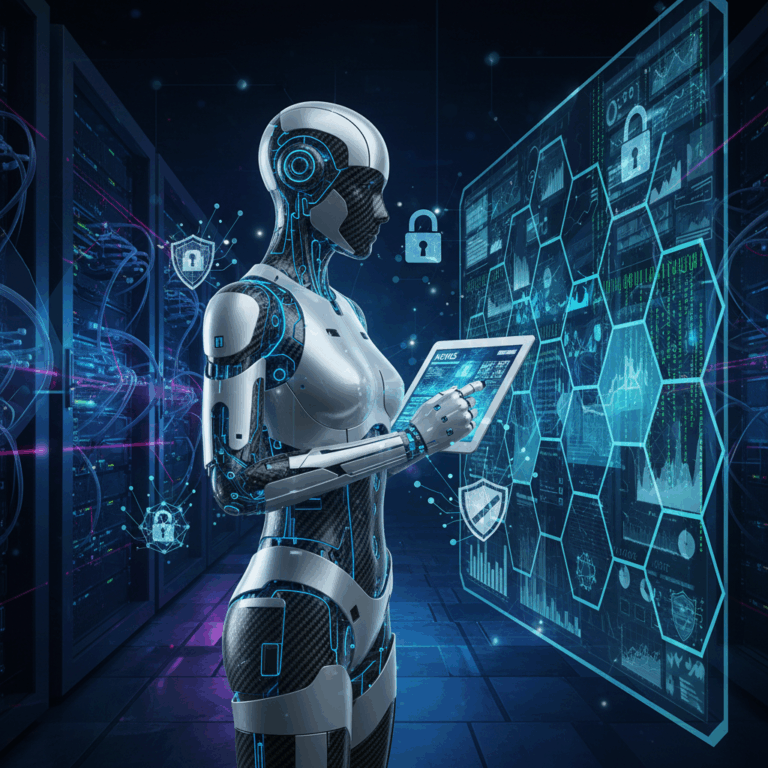
Impact of AI on current cybersecurity
The artificial intelligence it has transformed cybersecurity, offering more efficient tools to identify and mitigate threats in a complex digital environment.
Thanks to AI, organizations can detect suspicious patterns and respond more quickly to attacks, strengthening the protection of sensitive systems and data.
Its role is twofold, since it enhances defense, although it also represents challenges against sophisticated threats generated by cybercriminals.
Advances in threat detection and response
Modern AI systems analyze large volumes of data to detect anomalous behavior that indicates potential attacks, improving accuracy in threat identification.
These technologies allow security teams to act quickly against incidents such as malware or intrusions, minimizing potential damage.
Additionally, AI uses machine learning to adapt to new attack tactics, becoming increasingly effective in cyber defense.
Automation and analysis in real time
AI facilitates the automation of repetitive processes, freeing professionals from manual tasks and allowing them to focus on strategic security approaches.
Real-time analysis makes it possible to respond instantly to emerging threats, considerably reducing detection and mitigation time.
This capability improves operational efficiency and reduces human error, resulting in greater reliability of digital protection systems.
Challenges and risks of AI in cybersecurity
The incorporation of AI in cybersecurity also brings importance challenges and risks which must be addressed to protect digital systems effectively.
Cybercriminals take advantage of generative AI to develop more sophisticated attacks, putting the integrity and confidentiality of information at risk.
This dual use of AI requires advanced strategies to mitigate its negative effects without curbing its benefits in digital protection.
Malicious use of generative AI
Generative AI allows attackers to create more complex and difficult-to-detect attack tools, such as adaptive malware and custom attacks.
This increases the difficulty in identifying threats, as malicious systems can evolve and evade traditional defenses.
Additionally, cybercriminals can automate phishing and other malicious methods, multiplying the scale and effectiveness of their fraudulent campaigns.
Deepfakes and advanced phishing
Deepfakes allow digital identities to be impersonated with fake videos or audios, facilitating fraud and social manipulations on networks and platforms.
Advanced phishing, powered by AI, generates highly credible and segmented messages, deceiving even expert users and security systems.
These techniques pose serious threats to digital trust and can cause significant financial and reputational damage.
Fraud and misinformation facilitated by AI
AI generates fake content and misinformation on a large scale, contributing to deceptive campaigns and manipulations in digital environments.
This phenomenon affects both individuals and organizations, making it difficult to verify the veracity of the information they receive.
Consequently, vulnerability to economic fraud, political disinformation and other social attacks increases.
AI solutions and benefits for digital advocates
AI offers effective solutions for those who defend digital systems, optimizing the detection and prevention of threats in real time.
Its ability to process large amounts of data allows it to anticipate attacks, improving the cyber resilience of organizations and companies.
In addition, it facilitates risk management by prioritizing and automating tasks, increasing the work efficiency of security teams.
Prediction of malicious behavior
AI-based systems analyze historical patterns to identify early indicators of malicious activity, anticipating potential attacks.
This predictive approach enables automatic alerts that improve protection and reduce the likelihood of serious incidents on systems.
Artificial intelligence adapts to new tactics of attackers, continually updating its models to maintain high precision.
Thus, digital advocates can focus on emerging threats with greater information and proactivity.
Risk prioritization and automation
AI helps prioritize the most critical risks, focusing limited resources on the threats that pose the greatest danger to the organization.
Automates repetitive tasks and response processes, reducing operational burden and minimizing human errors during incidents.
This level of automation allows specialists to dedicate themselves to strategic tasks, increasing global defense capacity.
Perspectives and recommendations for the future
The investment in AI for cybersecurity it is becoming increasingly crucial in the face of the increasing sophistication of digital threats facing organizations.
Incorporating technologies based on artificial intelligence will allow maintaining an active and adaptive defensive posture against emerging cyberattacks.
A proactive approach with AI helps balance resources and anticipate risks in a rapidly evolving digital environment.
Importance of investment in AI for cybersecurity
Allocating funds to AI developments strengthens detection and response capacity, optimizing the protection of critical infrastructures and sensitive data.
Additionally, the investment encourages innovation in automated solutions that improve efficiency and reduce incident reaction times.
It is essential that both public and private entities prioritize these resources to confront increasingly complex and sophisticated threats.
Balance between opportunities and threats
AI offers enormous benefits for digital defense but it is also a tool for advanced attacks, so responsible and regulated use is necessary.
The challenge lies in maximizing the advantages of AI and minimizing risks through cybersecurity policies, training and strategic alliances.
Only with a balance between innovation and robust controls can a secure and reliable future in the digital field be guaranteed.