Interaction between AI and digital artists
Artificial intelligence (AI) has emerged as a key ally in the field of digital art, revolutionizing the way works are created and conceptualized. Its impact is especially notable in automated image generation.
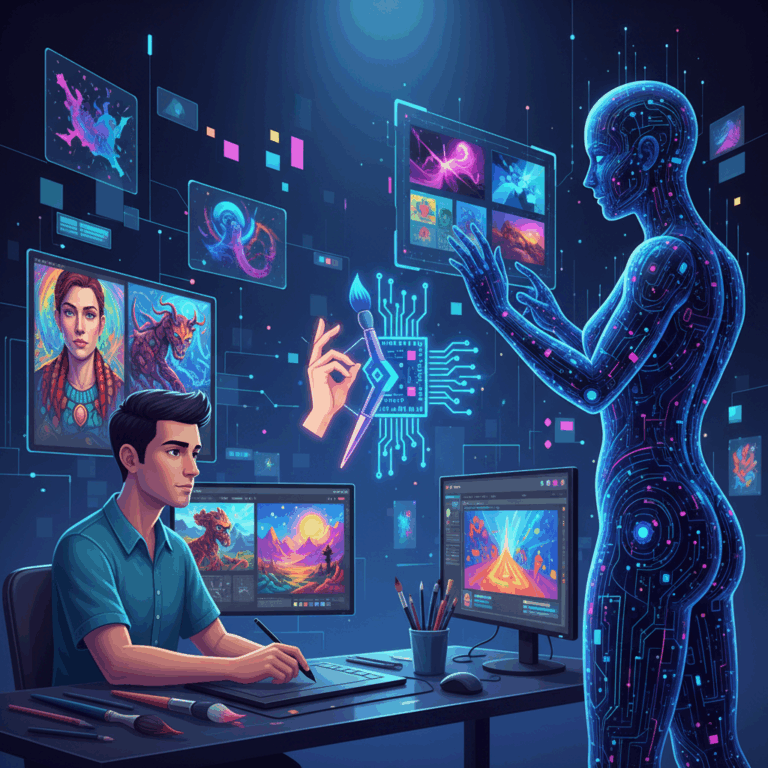
Digital artists take advantage of these technologies to optimize creative processes, but the artistic essence continues to be guided by human vision, which gives meaning and context to each work. AI does not replace, but rather expands, the possibilities.
AI tools that enhance artistic creation
Tools like Midjourney, DALL-E, and Stable Diffusion allow you to generate stunning images from simple textual prompts, accelerating processes that previously required advanced technical skills.
These technologies make it easy to test new combinations of colors, styles and concepts quickly, in addition to offering variants for the same idea, opening new avenues for artistic experimentation.
Automating repetitive tasks frees up creators' time, allowing them to focus on the conceptual and emotional part of art, strengthening the dialogue between human creativity and technology.
The role of the artist as curator and collaborator
In this new paradigm, the artist is not replaced but becomes a curator and guide, selecting and modifying the productions generated by AI to provide purpose and aesthetic coherence.
The artist provides sensitivity, context and meaning, applying his criteria to guide the final result, so that the work reflects human creative intentions and not just technical capabilities.
Human-machine collaboration redefines authorship as the creative process becomes shared, but imagination and choice remain essential functions of the digital artist.
Debates about replacing artists with AI
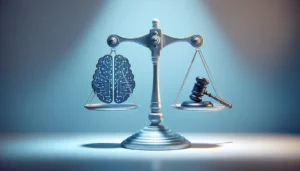
The debate about whether AI can replace digital artists revolves around their technical capabilities in the face of the emotional and creative limitations that characterize human beings.
Although AI can produce visually striking images, the emotional and personal essence of art remains the exclusive domain of human creators. This contrast fuels the current discussion.
Additionally, there are concerns about the risks involved in delegating technical and commercial tasks to AI, as well as the impact on the perception of originality and authorship in digital art.
Technical capabilities and emotional limitations of AI
AI is capable of generating works with high visual precision, replicating styles and color combinations quickly and efficiently. This makes it valuable in technical aspects of digital art.
However, it lacks emotions, intentionality and personal experience, elements that define a work with depth and meaning, aspects that only the artist can truly contribute.
Human creativity includes expression of feelings and cultural context, capabilities that AI can only imitate externally, but without understanding or feeling, limiting its authentic artistic contribution.
Risks in technical and commercial tasks
Automating technical tasks produces an increase in the speed and volume of creation, which can displace artists in areas where quantity exceeds quality and uniqueness.
This phenomenon generates concern in the commercial field, given that repetitive and less technically complex jobs could be replaced by AI systems, affecting the local creative economy.
However, experts highlight that human supervision remains crucial to maintaining originality and preventing art from becoming a massive product with no conceptual value.
Perception of originality and authorship
AI generates works based on previous learning, which calls into question the originality of its production and raises questions about who is the true author of the resulting creation.
Artists and critics maintain that authorship resides in the human who provides vision, selection and meaning, while AI acts as a tool that facilitates, but does not create from intention.
This debate redefines traditional concepts, inviting us to rethink the collaboration between humans and machines in the creative process and the way we value artistic authenticity.
Historical impact and evolution of art with AI
The introduction of artificial intelligence in digital art marks a historical chapter in the evolution of artistic creation. Each technological advance has transformed the role of the artist.
From the camera to AI, technical innovations have expanded possible methods and expressions, without replacing the human essence in artistic production.
Technical innovations and transformation of the artistic role
AI tools allow you to automate complex tasks and explore new styles, generating visually innovative works that redefine the traditional limits of digital art.
The artist, far from being replaced, adopts a role of curator and collaborator, guiding algorithmic creation with his vision and sensitivity to achieve pieces with meaning.
This symbiosis between human and machine drives new aesthetic currents and creative concepts, where AI expands possibilities without nullifying the importance of the human factor.
Future of digital art with AI
The future of digital art with AI is emerging as a growing collaboration between human creativity and the technical capacity of algorithms. This link will open new artistic frontiers.
The synergy between humans and machines promises to expand the spectrum of possibilities, where AI facilitates execution and the human being provides vision, sensitivity and aesthetic criteria.
Collaboration between humans and algorithms
AI algorithms are increasingly integrated into the creative process, serving as assistants that enhance inspiration and accelerate the development of complex ideas.
This collaboration allows artists to experiment with novel styles and optimize their workflow, creating hybrid works that combine technique and emotion.
Far from replacing, AI expands the repertoire of resources, becoming a partner that extends the creative capabilities of the artist, who maintains conceptual and aesthetic control.
Preservation of human artistic vision and sensitivity
Although AI offers powerful tools, the unique vision and emotional sensitivity of the human artist remain irreplaceable in creating works with depth and meaning.
The ability to interpret experiences, emotions and cultural context is exclusive to human beings, ensuring that digital art retains its authenticity and connection with the public.
The true value of art will continue to lie in the intention and interpretation that only the human mind and soul can bring, with AI as a complement, never a replacement.