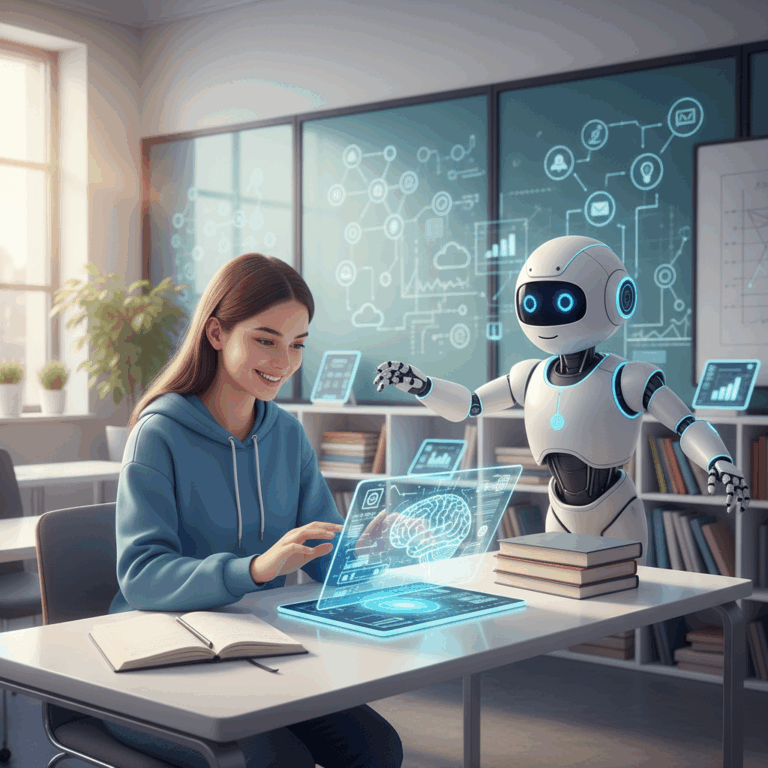
Benefits of AI in personalized learning
Artificial intelligence (AI) transforms education by offering personalized solutions that adjust to the pace and style of each student. This facilitates more effective and motivating learning.
Using intelligent tools, AI allows students to receive adapted content, improving understanding of complex topics and promoting more autonomous and efficient academic development.
In addition, personalization enables detailed monitoring of progress, which helps identify strengths and areas for improvement, favoring the continuous growth of each student.
Intelligent tutoring systems
Intelligent tutoring systems use algorithms to offer academic support tailored to students' individual needs. These systems detect difficulties and adjust explanations to facilitate learning.
By providing personalized exercises and clear explanations, these tutors help you better understand complex subjects, promoting a more accessible and tailored educational experience.
In addition, the systems monitor student progress, allowing constant feedback that drives continuous improvement and effective resolution of doubts.
Adaptive virtual assistants
Adaptive virtual assistants use AI to interact with students and offer personalized responses in real time, enhancing learning outside the classroom.
These assistants adjust their level of complexity based on each student's progress and style, providing flexible support when completing assignments and clarifying concepts.
Its constant availability guarantees that students can receive help at any time, facilitating continuous and autonomous learning.
Improved understanding and efficiency
Artificial intelligence facilitates understanding through tools that simplify and summarize complex texts. This makes the content more accessible and easier for students to understand.
In addition, AI optimizes the efficiency of study by offering answers and solutions quickly, allowing students to make better use of their time and improve their academic performance.
These technologies are integrated to transform the way students approach their tasks, promoting more effective and agile learning.
Summaries and simplification of texts
AI can analyze long texts and extract the most important points, facilitating quick understanding of academic content. This reduces reading load and improves information retention.
By simplifying the texts, technicalities are eliminated and clear explanations are used that adjust to the student's level, helping to face complex topics with greater confidence and understanding.
This feature is especially useful for students with reading difficulties or when large volumes need to be studied in a short time.
Resolution of doubts in real time
AI-based systems can answer queries instantly, offering precise and tailored explanations to each student. This avoids interruptions during study and maintains the flow of learning.
Thanks to this ability, students receive constant support, which reduces frustration and increases autonomy to solve problems on their own.
Immediate interaction promotes a more dynamic and personalized educational experience, addressing specific needs at all times.
Immediate feedback
AI provides instant assessments that identify errors and areas for improvement, allowing students to correct their errors in a timely manner and learn from them.
This continuous feedback drives active learning by encouraging constant review and practice directed according to individual progress.
Teachers also benefit from receiving accurate data to adjust their educational strategies and support their students more effectively.
Continuous support and accessibility
Artificial intelligence offers constant educational support, allowing students to access help outside of school hours. This facilitates more flexible learning adapted to your needs.
Thanks to permanent availability, students can resolve doubts and practice at any time, promoting autonomy and continuity in their academic development.
24/7 availability and support outside the classroom
With AI tools accessible 24 hours a day, students receive real-time support without relying on fixed schedules, optimizing their time and providing ongoing support.
This permanent access facilitates self-directed learning and allows children to reinforce concepts or clarify doubts after class, improving their understanding and performance.
Additionally, AI can adapt to diverse study styles, offering personalized resources that fit individual needs, even outside the traditional classroom.
Impact on teachers and students
Artificial intelligence optimizes teaching work and improves students' learning experience. It facilitates educational management and promotes a more inclusive and adapted environment.
By automating administrative tasks, teachers can spend more time teaching and personalized attention, directly benefiting students and their academic performance.
Additionally, AI offers tools to detect risks and tailor early supports, contributing to a more equitable and effective education for all students.
Optimization of programs and administrative tasks
AI automates administrative processes, such as attendance and grade management, easing teachers' workload and allowing them to focus on teaching.
Likewise, it helps design personalized educational programs based on data, offering content and activities that best fit the needs of each group and student.
This optimization contributes to a more efficient use of school time and resources, improving the quality and organization of the educational process.
Inclusion and early detection of risks
AI technologies make it possible to identify students who face difficulties or risks of dropping out by analyzing learning patterns and behaviors.
Thanks to this early detection, personalized support strategies can be implemented, promoting inclusion and preventing students from being left behind or excluded.
AI also adapts content and methods to various capabilities, promoting a more accessible and equitable educational environment for all students.